You've seen the same names at the top of every comparison site for years. You've watched their subscriber counts climb, their ads follow you around the internet, their Trustpilot scores tick upward... and wondered what, exactly, they're doing that you're not.
Here's the uncomfortable bit: most of what separates the best leasing brands in the UK from everyone else isn't budget. Yes, budget can make a material difference to your business' growth, but there's something way more important to consider: decisions.
The businesses who make specific, deliberate and strategic decisions about how they present themselves and their brand, where they show up, and what they say when they get there are the ones that do something very important indeed. They differentiate in a crowded market.
What's beautiful about marketing is that the end product is usually designed to be public facing. Because the marketing output is out in the ether, it means we can learn from it, and If you can learn from it, you can improve upon it.
It's worth noting at this point that we're not encouraging you to actively copy Carwow's YouTube and wider content empire or Select Car Leasing's SEO strategy word-for-word. This is about using an analytical lense to understand what it is that sets the best brands apart. Whether it's brand identity, SEO, paid media, social, content and customer experience, there's usually something you can learn from in order to speed up your own business' growth.
For the most part, we've chosen brands that lead in a specific discipline. They aren't necessarily the biggest or the best-known brand, but the ones doing something worth learning from.
What this article covers
- Brand identity: Jurni
- SEO: Select Car Leasing and Nationwide Vehicle Contracts
- Paid media and audience strategy: Vanarama, ZenAuto and Carwow
- Social media: Carwow
- Content and thought leadership: Carwow and Vanarama
- Customer experience: Hippo Leasing and Vanarama
- Reviews: Select Car Leasing and Synergy Car Leasing
- What this means for independent brokers
Brand Identity: What Jurni Gets Right
The team at Jurni made a decision that most leasing companies never make. They chose a name that doesn't describe what they sell.
This approach is surprisingly unique in the leasing sector.
Let's think about it for a moment.
Select Car Leasing.
Nationwide Vehicle Contracts.
Hippo Leasing.
Every name is a description; functional, sensible, built for search visibility.
Jurni threw that playbook out and picked a name that signals an experience, not a transaction. It's exactly that choice unlocked everything a brand that differentiates.
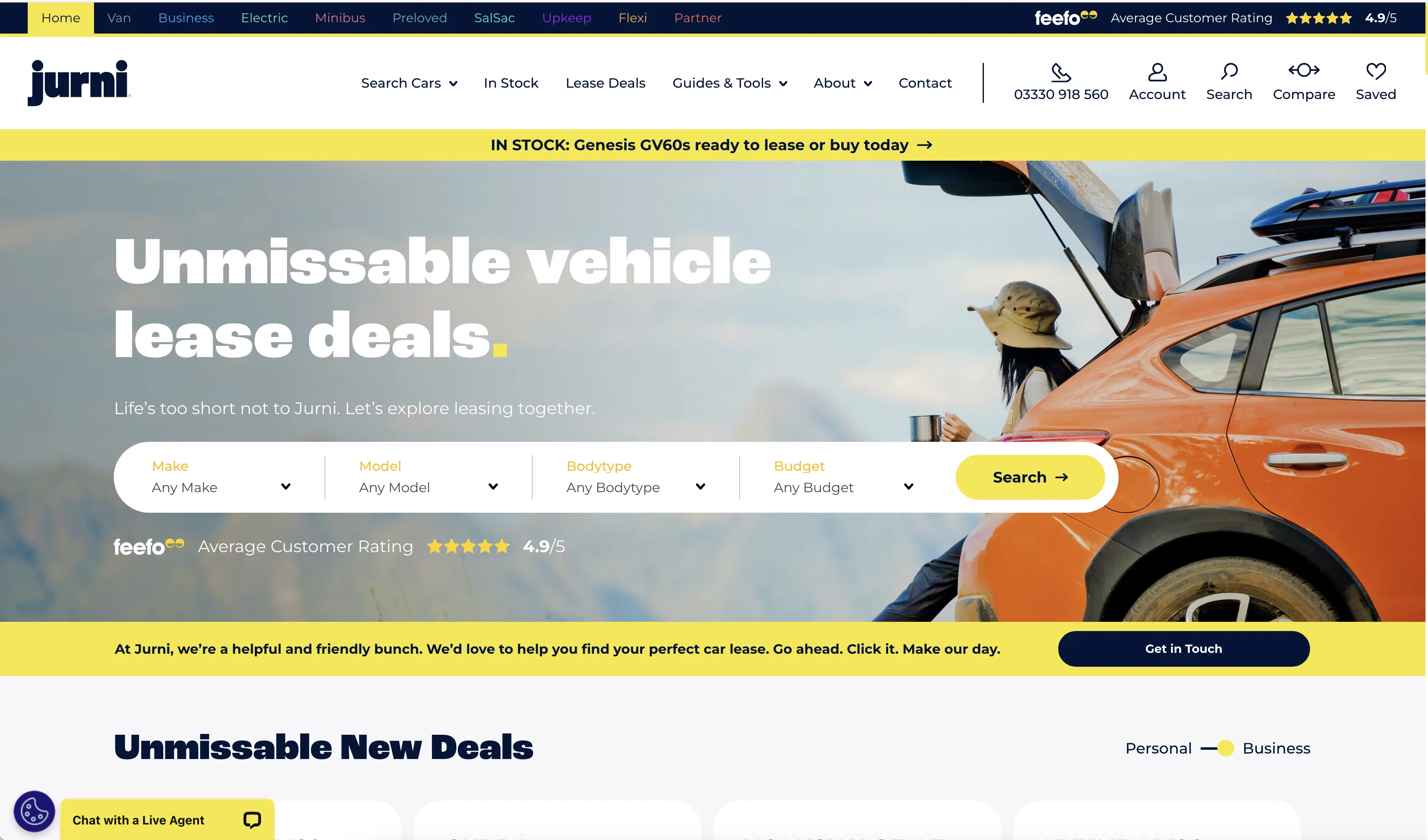
Jurni's homepage. Clean, modern, intentional.
The visual identity tells the same story. If you visit their site and you'll notice what's missing before you notice what's there: no generic stock photos of salespeople shaking hands (Don't get me wrong, finding decent images is a perennial challenge in this space, I've been there!), no walls of manufacturer badges, no "DEALS FROM £199/mo" banners fighting for your attention.
Instead, Jurni's approach is to deliver clean design that sits closer to a fintech app than a motor trade website, focusing heavily upon the human and in most cases, highly emotive experience of leasing a car. Typography, colour and imagery that all feel like they were chosen by the same person, on the same day, with the same brief.
Believe me, that matters.
The tone is consistent, and It reads like someone talking to you, not at you. Someone who assumes you might be leasing for the first time, might find the process confusing, and would rather be guided through it than pushed.
If you can build emotional connection with a customer, you'll established a much stronger relationship with your customer for the long term, driving up customer lifetime value and, in turn, your business' profitability.
"We don't value things; we value their meaning. What they are is determined by the laws of physics, but what they mean is determined by the laws of psychology."
— Rory Sutherland, Alchemy
Here's where it gets interesting: that brand identity isn't just window dressing; it's become the engine of their growth. Jurni is now one of the UK's largest independent brokers. They've acquired DriveElectric, a specialist EV leasing business, and launched a partner programme bringing other brokers into their network. It's a brand built around "experience over transaction", that can stretch into EV, into partnerships, into new verticals, without the identity cracking.
This is exactly what a brand built around "cheap car leasing" will always struggle to do.
Try this
If you were to open your website in an incognito tab and cover the logo, could it belong to any one of 15 other brokers? If your answer is yes, that's not a design problem; it's a positioning problem. You don't need astronomical budgets to fix it, you just need to make choices and commit to them: a visual direction, a tone of voice, a point of view that's yours and no one else's. Our guide to leasing broker brand positioning covers how to build this foundation.
SEO: How Select Car Leasing and Nationwide Vehicle Contracts Dominate Organic Search
SE Ranking data · UK market · Estimated organic traffic
Organic Search Visibility Over Time
Estimated monthly organic traffic based on keyword positions and search volumes. Shows the compound effect of sustained SEO investment; note how Select's content architecture has driven near-continuous growth since 2020.
Click a brand to focus it; the chart rescales to that brand's range so you can see its trajectory clearly. Click additional brands to compare them side by side. Click a focused brand again to unfocus it. Dashed lines show the overall trend direction. Hover for monthly figures.
Carwow and LeaseLoco are included for comparison as leasing aggregators/car marketplaces; their traffic spans broader verticals than leasing brokerage alone. All data is estimated by SE Ranking based on keyword positions and search volumes, not reported figures.
As the chart above shows, Carwow dwarfs every other brand in raw organic traffic. That said, their approach is an interesting and somewhat unique one that an independent leasing broker might struggle to follow.
Carwow is a leading car marketplace and editorial powerhouse; their organic footprint spans new car buying, used car selling, video-driven reviews, and editorial content across every segment of the automotive market.
It's a phenomenal content marketing engine and SEO operation that spans lots of services. They took an audience-first approach, establishing an audience footprint unlike any other in the UK, which has allowed them to introduce ancillary services, like leasing, and scale them phenomenally quickly.
Although it's a broker, you can't compare it like-for-like with a broker. (We dig into what makes Carwow's content ecosystem so effective (and what brokers can actually take from it) in the social media and paid media sections below.)
Strip Carwow out and the picture changes. The two names that consistently dominate leasing-specific organic search are Select Car Leasing and Nationwide Vehicle Contracts. That's not luck, and it's not just longevity, although there is some of that at play.
Instead, it's architecture. Deliberate, methodical, and very much worth understanding in detail.
Select Car Leasing: the hub-and-spoke model
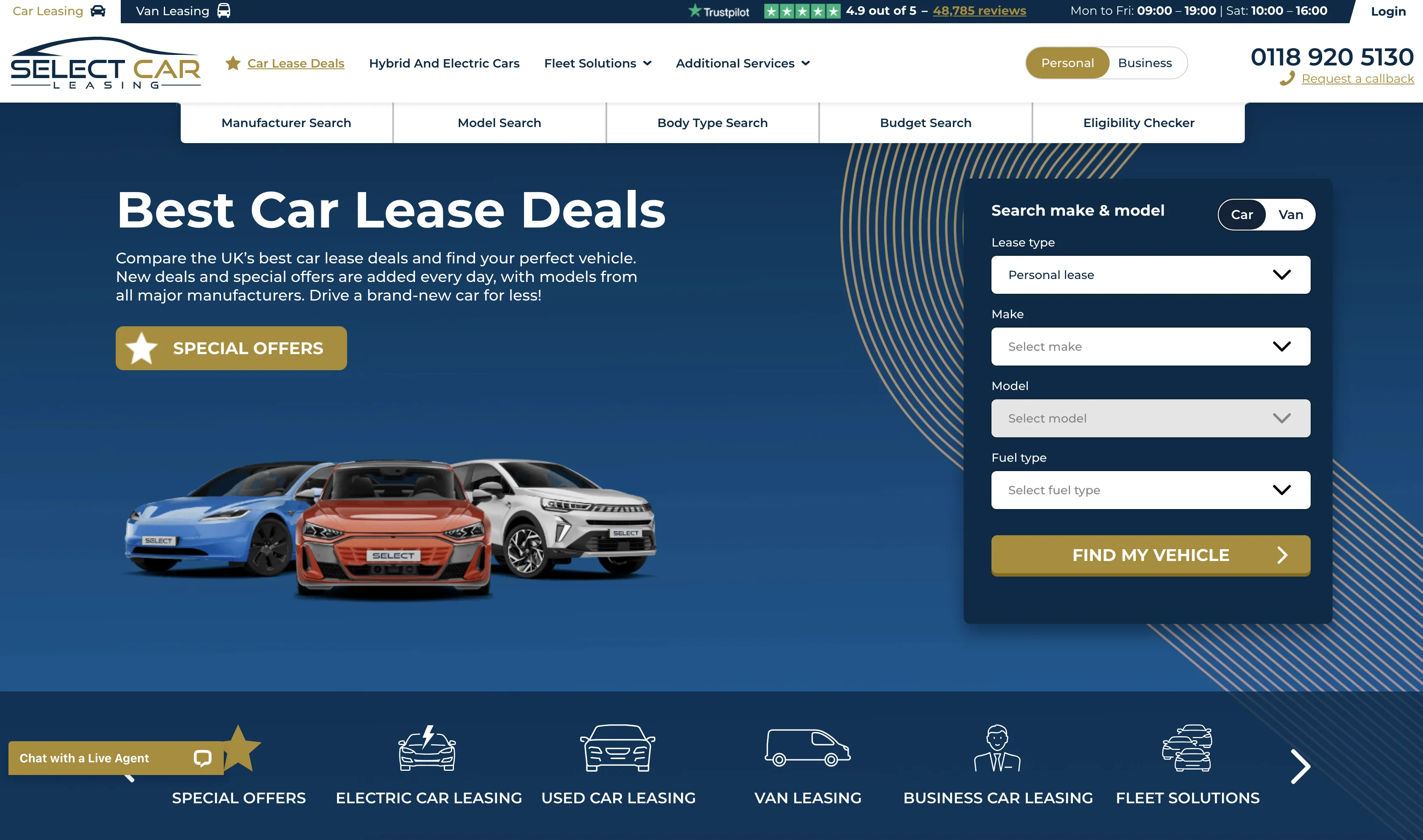
Select Car Leasing's homepage. Every element is a doorway into their hub-and-spoke content architecture.
Select's organic dominance is built on a deceptively simple idea: create a page for every commercially valuable search term, and connect them all in a logical hierarchy.
Their URL structure mirrors how people actually search:
/car-leasing/targets "car leasing" as the top-level hub/car-leasing/audi/targets "Audi lease deals"/car-leasing/audi/a3/targets "Audi A3 lease"/car-leasing/audi/a3/hatchback/targets body-type-specific queries
Every level is a landing page in its own right, Each page, at every level, uses unique introductory copy, structured deal listings, internal links to related models and parent pages, and FAQ sections targeting "People Also Ask" queries.
This isn't a flat database of car listings, it's rich a content architecture where each page feeds authority to the pages above and below it. For a head-to-head look at how Select's approach compares to the other brands on page one, see our SEO and CRO teardown of who ranks for "car leasing" in the UK.
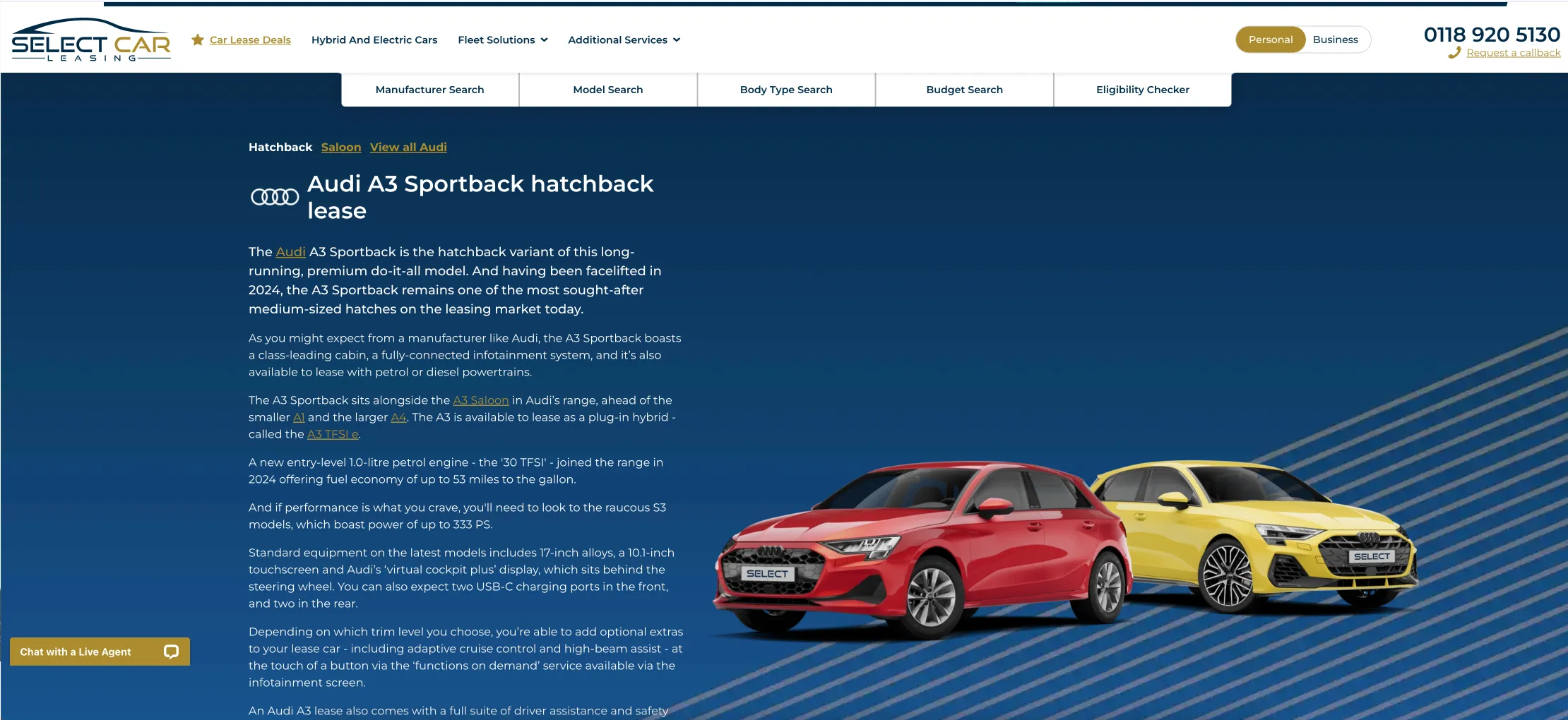
Select's Audi A3 Sportback page. Descriptive, keyword-rich editorial copy written specifically for this model, not templated filler. Every page in the hierarchy gets this level of investment.
Perhaps the most commercially significant application of this content architecture is in the way they tackle content right the way across the purchasing journey, all aimed at moving a customer further down the funnel: car reviews, leasing guides, comparison articles ("leasing vs PCP", "business vs personal lease"), glossary content explaining terms like residual value and mileage allowance. Everything leads ultimately to a lease deal and a conversion, right the way from earlier in their journey (before they know what they want) to sale.
The approach they take towards internal links itself deserves attention too. Breadcrumb navigation on every page, related deals blocks cross-linking between models in the same segment, contextual links within body copy connecting guides to deal pages and back again... every high-priority page is reachable within two or three clicks from the homepage. Nothing is orphaned or buried.
Nationwide Vehicle Contracts: programmatic SEO at scale
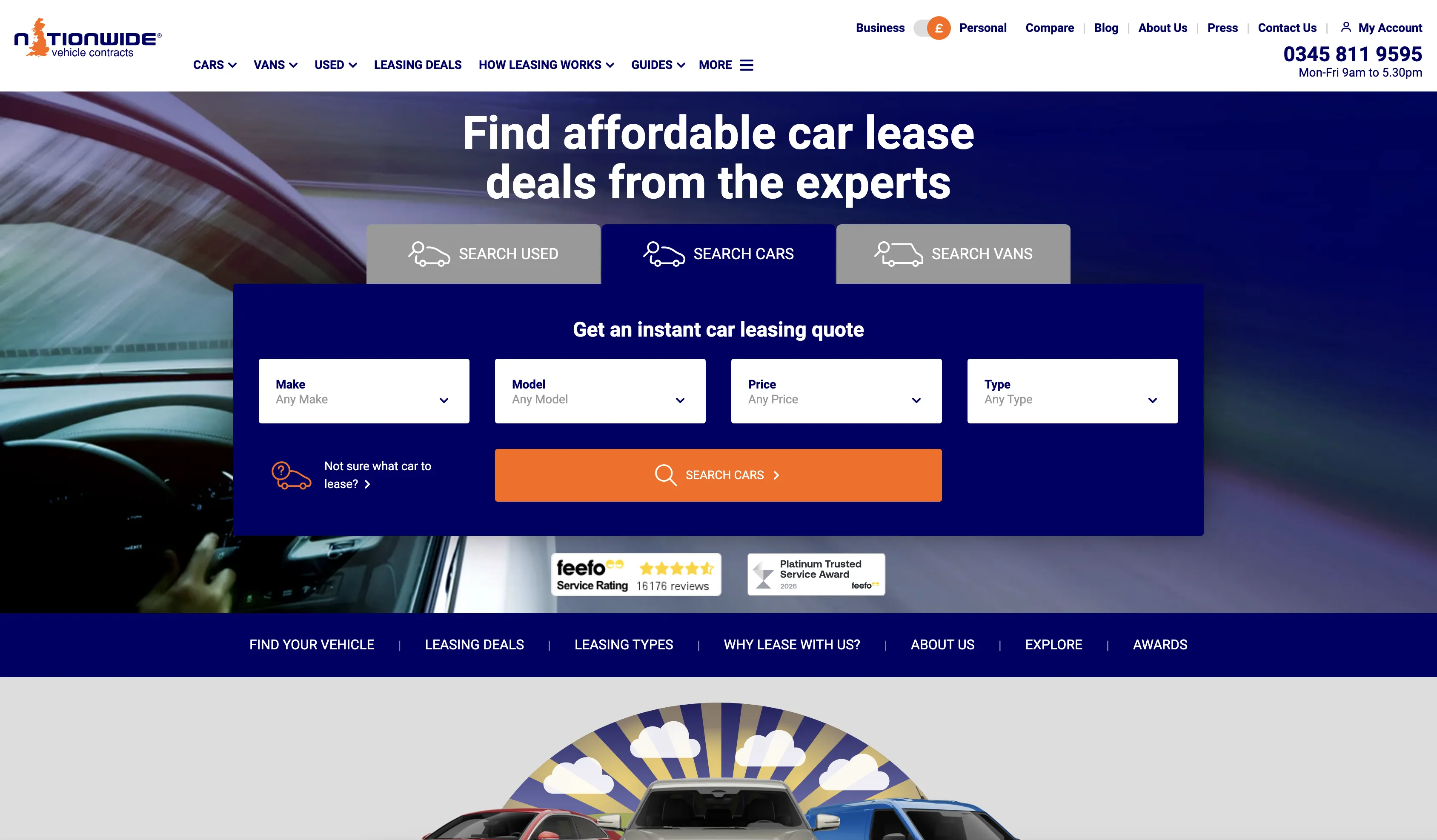
Nationwide Vehicle Contracts. Programmatic scale backed by genuine editorial investment at every level.
Nationwide takes a similar foundational approach and pushes it further. They've built a dedicated landing page for every searchable combination of make, model, body type and trim, culminating in thousands of indexed pages, each targeting a specific long-tail query.
If you want to give this approach a go, there's a subtle risk that you need to think about. Google penalises think, duplicated content. What Nationwide does brilliantly is lean into genuine editorial content at every level. Pages that carry deep, useful content and FAQ sections with often six or more highly relevant questions that answer search intent, as well as aggregate review data.
Even body-type pages get unique introductory copy and style-specific FAQs covering things like boot space and family suitability.
Someone sat down and wrote all of that.
...and it paid off.
Beyond content, Nationwide has really solid and thorough structured data too. It implements structured data across key page types including schema for vehicles, organisation credibility signals, and FAQ sections with the intent of improving search visibility.
On the informational side, Nationwide runs a guides hub covering nine structured categories (from business leasing to UK road law) alongside a dedicated FAQ hub linking to thirty-plus deep-dive articles. The blog targets both evergreen SEO content and topical, link-worthy pieces that earn coverage from industry press.
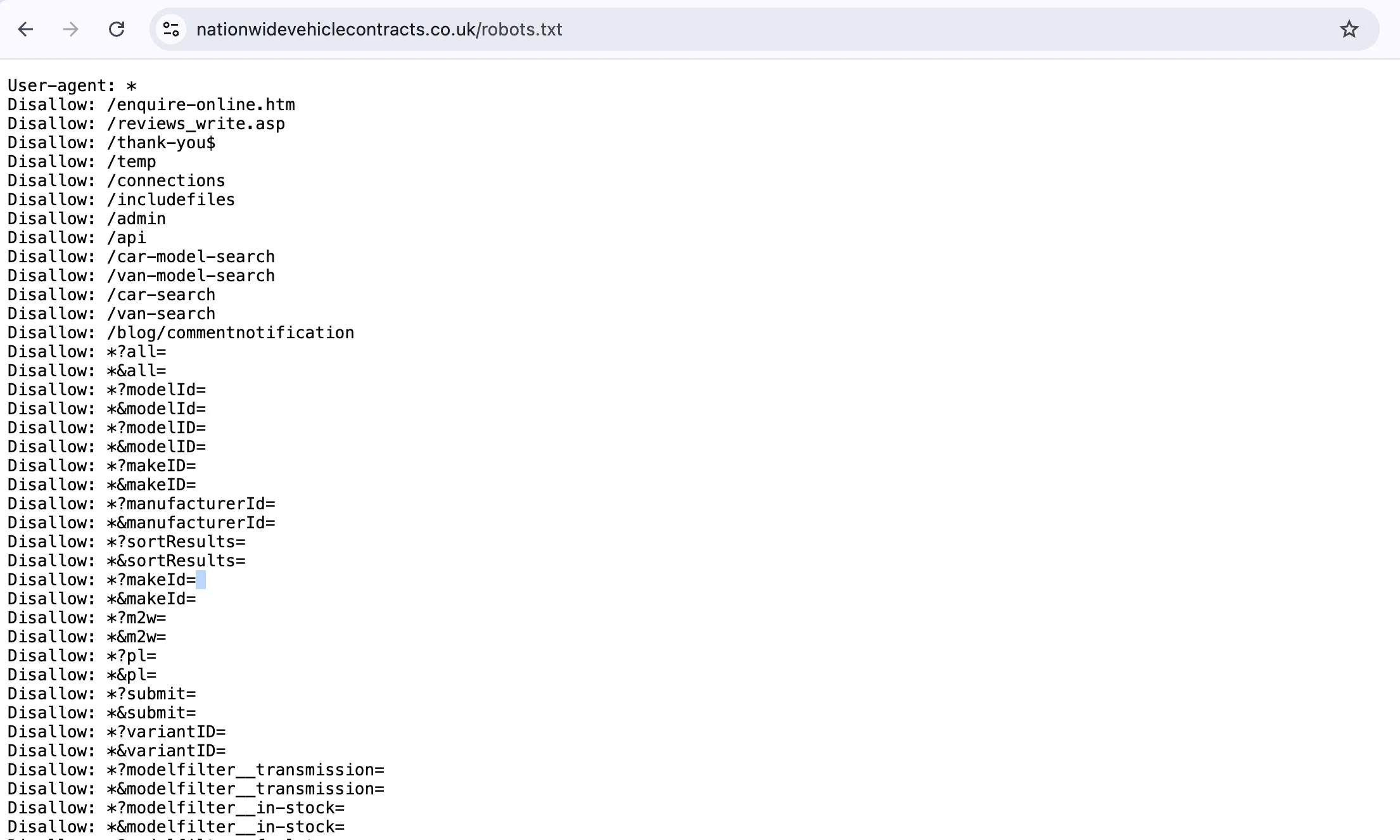
One technical detail worth noting: their robots.txt blocks all filter and sort parameters, preventing thousands of near-duplicate pages from consuming crawl budget. For a site generating this many pages programmatically, that discipline is what keeps the engine running clean.
Quick Case Study
When you browse a leasing site and filter by fuel type, sort by price, or adjust your mileage allowance, the website generates a new URL for every combination you select. Left unchecked, Google's crawler would attempt to index all of those URLs, thousands of near-identical pages showing slightly different cuts of the same vehicle listings. Nationwide Vehicle Contracts blocks all of those parameter-based URLs in their robots.txt file, telling crawlers to ignore them entirely. That means Googlebot spends its time indexing the pages that actually matter, manufacturer pages, model pages, deal listings, rather than burning through its crawl budget on filter combinations that no one is searching for and that add no unique value to the index.
The broker takeaway
You won't match Select or Nationwide for page volume. You don't need to. The lesson is structure, not scale. Ten well-built, deliberately interlinked pages, each one the best answer to a question your customers actually ask, will outperform a hundred disconnected ones. Start with pillar pages for your core offerings, build supporting content around the queries your best customers are searching, and link everything together with intent. Our complete SEO guide for leasing brokers and content architecture guide walk through how to build this at independent-broker scale.
Paid Media and Audience Strategy: Three Models Worth Studying
Most leasing brokers running Google Ads are locked in the same arms race: bid on generic terms, watch the budget drain, measure success by lead volume and try not to think too hard about what each lead actually cost. The brands doing paid well have each found a different way out of that trap, and one of them barely thinks about paid search in the traditional sense at all.
SE Ranking data · UK market · Estimated ad traffic value
Paid Search Visibility Over Time
Third-party estimates based on keyword positions, search volumes and CPC data, directional rather than exact, but useful for comparing relative investment across brands.
Click a brand to focus it; the chart rescales to that brand's range. Click additional brands to compare side by side. Click a focused brand again to unfocus it. Dashed lines show overall trend. Hover for monthly figures.
Carwow is a car marketplace whose paid spend spans buying, selling and leasing, not leasing alone. LeaseLoco operates as a leasing aggregator. All figures are SE Ranking estimates based on keyword positions, search volumes and CPC data, not reported ad spend.
Vanarama: the brand play that made every click cheaper
At their peak, Vanarama was the biggest leasing-specific PPC spender in the UK market; SE Ranking data shows estimated monthly ad traffic values approaching £195,000 in early 2022, with campaigns running across brand, generic and model-specific terms, dynamic ad copy pulling in live prices and stock availability. Serious operation. Serious budget.
But here's the bit most people miss. The smartest thing Vanarama did for their paid search wasn't a bidding strategy or an ad format. It was sponsoring a football league.
Their long-running National League sponsorship (the league carried the Vanarama name for over a decade, through to the 2025/26 season) put the brand in front of millions of people who weren't searching for van leasing. That awareness did something quietly powerful: it turned generic searchers into branded searchers. People typing "Vanarama" instead of "van leasing deals." And branded search converts better and costs a fraction of the CPC of generic terms.
How powerful was that brand equity? Vanarama has since scaled their paid spend back dramatically, from six-figure monthly budgets to near-zero by early 2026. And yet the brand persists. The National League investment built a layer of recognition that continues to drive branded search volume long after the ad budget was cut. That's the difference between renting attention and owning it.
You can't sponsor a football league. But you can sponsor a local business event, show up consistently on LinkedIn, get quoted in trade press, or appear on an industry podcast. Anything that puts your name in someone's head before they search makes the click cheaper when they do.
ZenAuto: competing on clarity, not price
ZenAuto (part of the Zenith Group, with over 162,000 vehicles on fleet) took a different path entirely. While most leasing ads fight over who can display the lowest monthly number, ZenAuto's ads barely mention price at all.
Their messaging leads with a single idea: everything's included. One monthly payment covering the lease, maintenance, insurance and breakdown cover. The ad copy and landing pages speak directly to people who've been confused by leasing before, or who've been stung by costs that weren't in the headline number. The proposition isn't "we're cheapest." It's "you'll never be surprised."
That's a message aimed at a specific person, someone who'll happily pay more for certainty. And it works, because it attracts higher-quality leads who convert better and produce healthier margins.
The lesson is bigger than ZenAuto. If your positioning is distinct enough ("we specialise in fleet EV transition" or "we handle salary sacrifice for professional firms") your ads can lead with that proposition instead of joining the race to the bottom on monthly price. You'll get fewer clicks. The ones you get will be worth more.
Carwow: the content ecosystem that makes paid search an afterthought
Carwow deserves a mention here not because they're a leasing broker (they're not) but because they've built something most brokers haven't even considered as a strategy: an audience they own.
Carwow's paid search spend dwarfs every leasing brand in the UK. SE Ranking data shows estimated ad traffic values that peaked above £500,000 per month. But here's what makes it different from Vanarama or ZenAuto: the paid spend isn't the engine. It's the exhaust.
The engine is content. Nearly eleven million YouTube subscribers. 4.5 billion views. A written editorial operation that rivals automotive magazines. Carwow built an audience of people who genuinely want to hear what they have to say about cars, and then layered commercial services on top. New car buying. Used car selling. Leasing. Each one a monetisation route for an audience that already trusts them.
Their paid search operation is largely retargeting: serving deal-focused ads to people who've already watched their videos, read their reviews, or visited their site. They're not buying cold attention; they're converting warm attention they already earned. That's a fundamentally different economic model from bidding on "car leasing deals" against every other broker in the country.
You won't build Carwow's audience. But the principle matters for any broker: every piece of content you create, every LinkedIn post that gets shared, every YouTube video that helps someone understand the difference between a business and personal lease, it's all building an audience asset that makes your paid spend more efficient and your brand harder to compete with. The brokers who only spend on ads are renting attention month to month. The ones who also invest in content are building something they own.
Three strategies, one lesson
Vanarama proved that brand investment makes paid search cheaper. ZenAuto proved that positioning beats pricing. And Carwow proved that if you build the audience first, everything else gets easier. The common thread? None of them won by having the biggest bid on "car leasing deals." They each found a way to change the game rather than outspend the competition on someone else's terms. Our Google Ads guide for leasing brokers covers how to build campaigns around positioning rather than price.
Social Media: How Carwow Turned YouTube into an Acquisition Engine
Here's what social media looks like for most leasing brokers: a stock photo of a BMW, a monthly price overlaid in bold, posted to LinkedIn and Facebook, liked by three colleagues and seen by no one else. Repeat weekly. Wonder why it's not working.
The brands doing social well have figured out something that sounds obvious but almost nobody acts on: you have to make things people actually want to watch.
Carwow: what the content ecosystem looks like in practice
We covered Carwow's audience-first strategy in the paid media section, how they built an owned audience and layered commercial services on top. But it's worth looking at how that content engine actually works on a platform level, because the craft matters as much as the strategy.
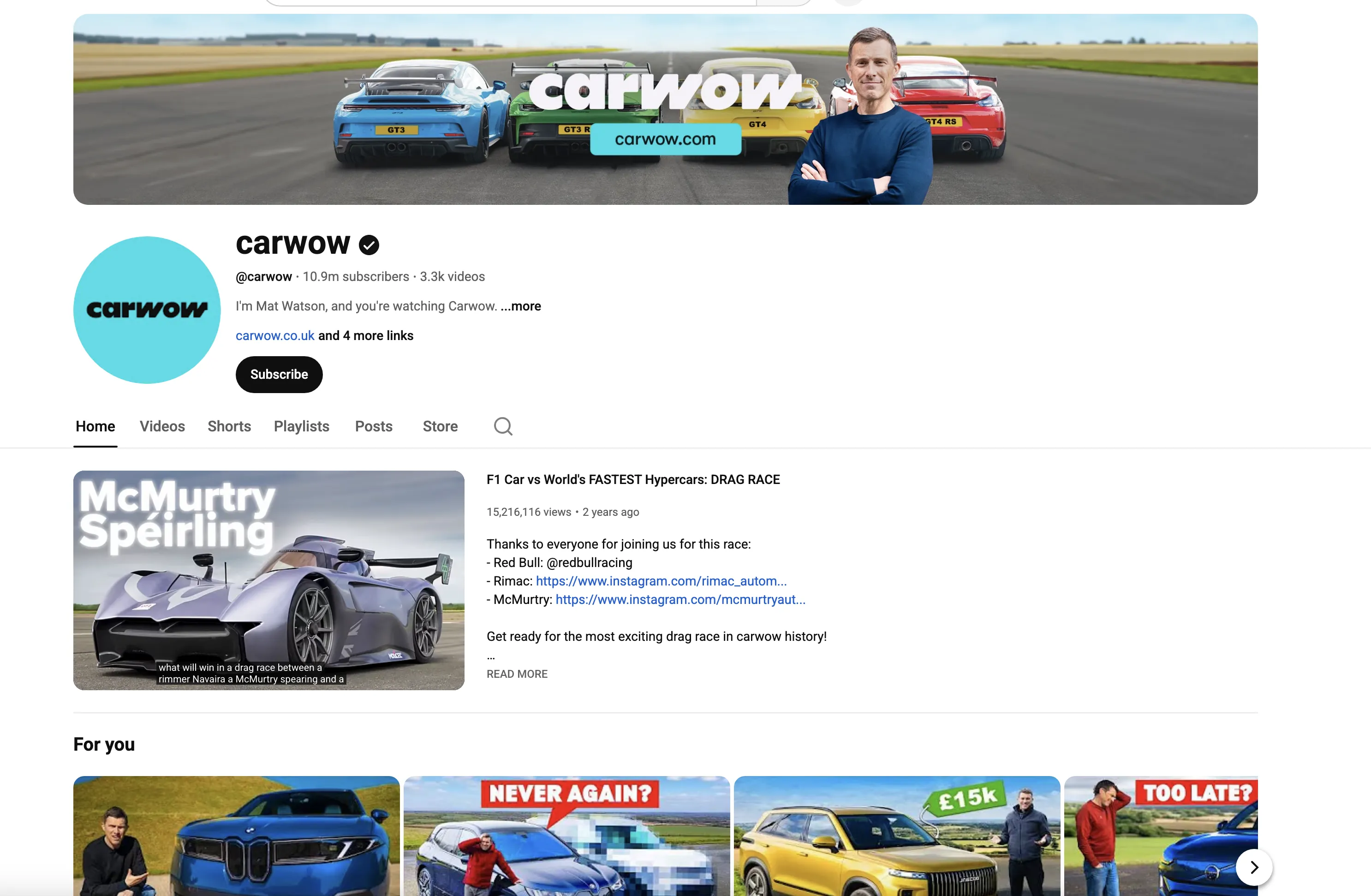
Carwow's YouTube channel. 10.9 million subscribers built on entertainment first, commerce second.
Mat Watson drag-racing supercars. Honest first drives that don't read like press releases. "How much did I actually pay?" videos that break the industry's silence on real-world pricing. It's entertainment first, and that's precisely why it works as marketing. People subscribe because they enjoy it, not because they're in the market for a car. But when they are in the market, Carwow is already in their head.
Could you build an eleven-million-subscriber channel? No. But you have something Carwow doesn't: specificity. A broker who can talk honestly about which EVs actually suit a sales rep doing 30,000 miles, or why a particular funder's early termination terms are worth avoiding, is offering something no generalist platform can. And specificity, delivered with personality, travels further than production value.
The broker takeaway
You don't need a production budget. You need a perspective. The independent brokers we've seen do best on social are the ones where a founder or senior figure talks honestly (on LinkedIn, on a phone camera, in their own voice) about the realities of the industry. A 60-second video comparing two similar models from a broker's perspective, filmed at a desk with natural light, will outperform a professionally designed deal graphic every single time. Because people connect with people, not with artwork. Our guide to social media marketing for leasing brokers covers which platforms actually drive results and how to approach each one.
Content and Thought Leadership: Who's Actually Publishing Useful Things?
Most leasing companies have a blog. You'll find it if you scroll to the footer and click a link that hasn't been updated since 2023. Three posts about "the benefits of leasing", a tax update from two budgets ago, and something about electric vehicles that mentions the plug-in car grant (which ended in 2022).
The brands getting content right are playing a completely different game.
Carwow: editorial quality as a competitive moat
Carwow's written content has the same quality as their video work; it's honest, it's detailed, and it respects the reader's intelligence. Their car reviews are real assessments, not thinly veiled sales copy. Their buying guides tackle the questions people actually have, including the uncomfortable ones about depreciation and total cost of ownership. Their market commentary is opinionated enough to be interesting.
The result is content that earns links, citations and return visits, not because it's optimised, but because it's genuinely the best answer to the question the reader had when they started searching. That's what topical authority actually looks like in practice.
Vanarama: B2B thought leadership done well
Vanarama's content operation is strongest on the B2B and fleet side, and that's where the opportunity is richest for anyone paying attention. Their guides on electric van leasing, fleet electrification planning, and BIK tax implications are genuinely useful to fleet managers and business owners making procurement decisions. Not "useful for a leasing website", actually useful.
With 58% of ZenAuto's pending orders now electric (ZenAuto sits under the same Zenith parent as Vanarama's fleet competitor), the EV transition isn't coming; it's here. The brands producing authoritative content around it now are becoming the trusted advisors. Everyone else will be catching up.
Vanarama has also invested in recurring formats (podcasts and video content around commercial vehicle trends) that build a returning audience rather than chasing one-off search traffic. That matters more than most brokers realise. A brand that publishes reliably, even modestly, becomes a reference point. A brand that publishes once in a while is just noise.
The honest truth
The bar for content in this sector is on the floor. Most brokers publish nothing useful. The ones who do, publish generic summaries that add nothing a reader couldn't find faster on Google. If you commit to publishing one genuinely specific, genuinely useful article a month, the kind that answers a question nobody else has bothered to answer properly, you will build more authority in a year than most competitors will build in five. In a niche this underserved, the gap between "nothing" and "best available" is smaller than you think.
Customer Experience: Where the Real Differentiation Happens
Let's talk about the thing that actually matters most, and the thing that gets the least airtime in marketing conversations.
A customer who tells their mate about you is worth more than any ad. A client who renews without shopping around costs you almost nothing to acquire. You know this already. Every broker does. The question is whether you've built the infrastructure to make it happen on purpose, or whether you're just hoping it happens by accident.
Hippo Leasing: winning in the silence
Hippo Leasing, based in Blackburn, carries a 4.6-star rating on Trustpilot from over 12,000 reviews. Read through a few hundred of them and a pattern emerges: customers keep praising the same thing. Not the deals. Not the prices. The communication.
Here's why that matters. When someone orders a factory-build vehicle, there's a window (typically eight to sixteen weeks) where they've paid their initial rental and have... nothing. No car. No update. Just a confirmation email from two months ago and a growing suspicion that something's gone wrong.
That silence is where most negative leasing experiences are born. Not in the deal. Not in the handover. In the waiting.
Someone at Hippo decided that window was the moment that mattered most. So they built a communication cadence around it: "your vehicle has been ordered", "production is confirmed for week 23", "delivery is booked for the 15th." Simple messages. Not expensive to send. But they turn the most anxious part of the customer journey into a reassuring one, and they're the reason Hippo's review profile looks the way it does. Our follow-up framework for leasing brokers breaks down exactly how to build this kind of cadence.
Vanarama: CRM-driven retention at scale
On the retention side, Vanarama has built something most brokers haven't even thought about yet. Their CRM operation tracks contract end dates and triggers a renewal sequence: reminders timed to when a decision needs to be made, guidance on end-of-lease options (return condition, mileage settlement, early termination), and "what's next" campaigns designed to convert a departing customer into a returning one.
The economics behind this are almost absurdly good. A renewing customer costs virtually nothing to acquire. Their credit is already approved. Their preferences are known. The deal can be structured around a vehicle they've already been browsing. The margin on a renewal is typically better than on a cold acquisition.
And yet most brokers let renewals happen passively. Some don't even track when their clients' contracts end. Think about that for a moment: the cheapest, highest-margin deal available to you is the one you've already earned, and you might not even know when it's due.
Where to start tomorrow
Two things. First: build a communication sequence for the order-to-delivery window. Three or four messages (email, text, whatever works) sent at key milestones between order and handover. It will cost you almost nothing and it will transform how your customers feel about you during the weeks when most brokers disappear. Second: open your CRM and check whether you can see, right now, which of your clients' contracts are ending in the next 90 days. If you can't, that's the most valuable thing you could fix this week. Our CRM guide for leasing brokers covers how to set this up properly.
Reviews: The Most Undervalued Marketing Asset in Leasing
Every section of this article so far has focused on how brands attract attention. This one is about what happens after someone becomes a customer, and why it might matter more than everything else combined.
Reviews are the quiet engine behind the best leasing brands' growth. Not because brokers don't know they're important, but because very few treat them as a deliberate, measurable part of their marketing strategy. Most brokers let reviews happen passively. The ones winning treat them as a system.
Select Car Leasing: 48,863 reviews and a 4.9-star rating
Read that number again. Nearly fifty thousand reviews on Trustpilot, with an average score of 4.9 out of 5. That's not a review profile. That's a moat.
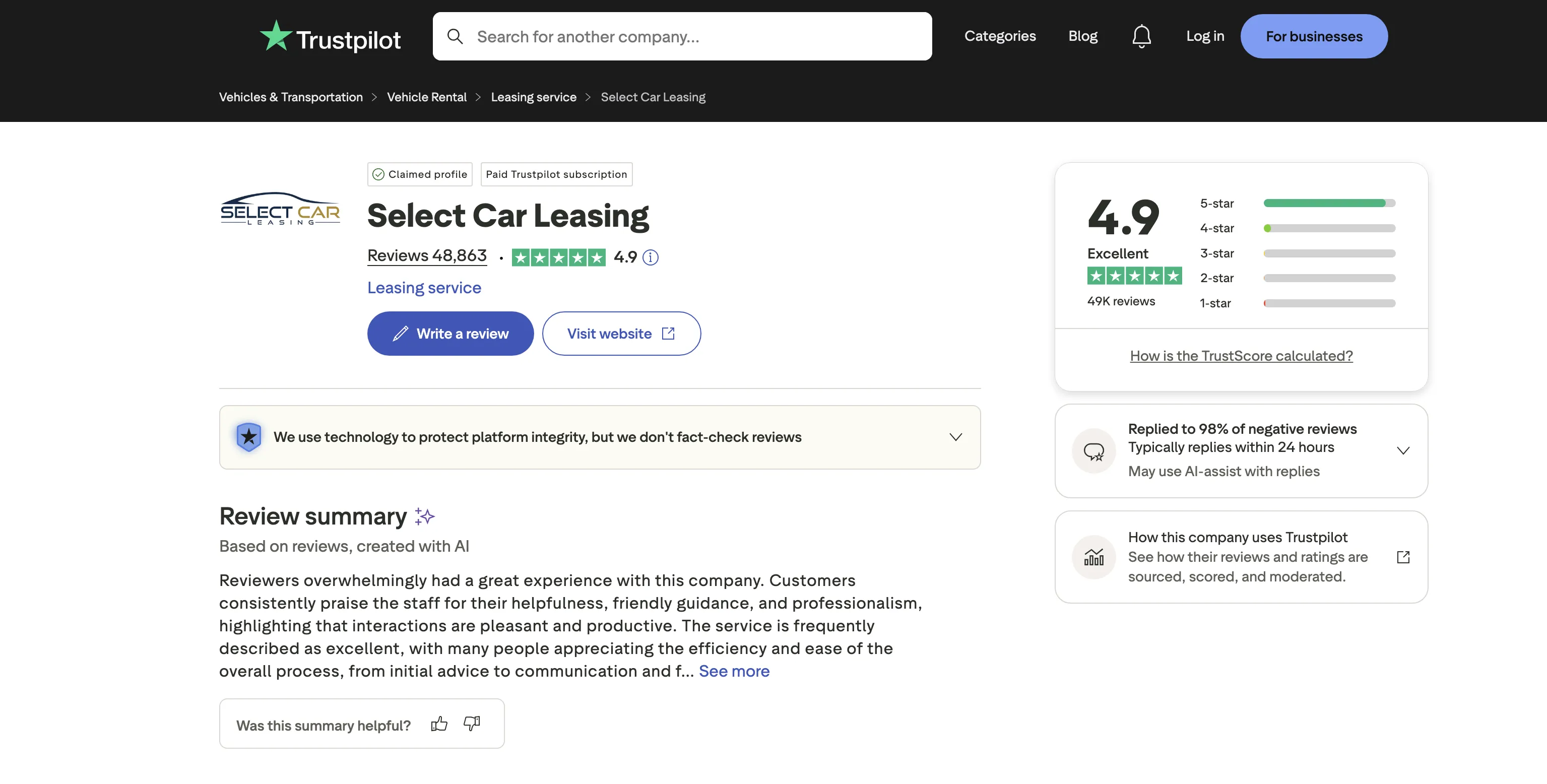
Select Car Leasing on Trustpilot. 48,863 reviews at 4.9 stars. The kind of trust signal that no amount of ad spend can replicate.
A review profile at this scale does several things simultaneously. It builds instant credibility with any prospect who searches the brand name. It generates a constant stream of fresh, keyword-rich user content that feeds organic visibility. It provides structured data (star ratings in search results) that improves click-through rates on every listing. And it creates a psychological barrier for competitors; when a customer is comparing two brokers and one has 48,000 five-star reviews, the decision is already made.
What makes Select's profile remarkable isn't just the volume. It's the consistency of the score at that volume. Maintaining 4.9 stars across nearly 50,000 reviews means the operational delivery is genuinely excellent at scale. You can't game that. You can only earn it.
Synergy Car Leasing: building trust through Feefo
Synergy Car Leasing has taken a different approach, building their review profile on Feefo rather than Trustpilot. With over 7,300 reviews and an "Exceptional" rating (4.8 for service, 4.8 for product), they've built a strong trust signal on a platform that operates differently from Trustpilot.
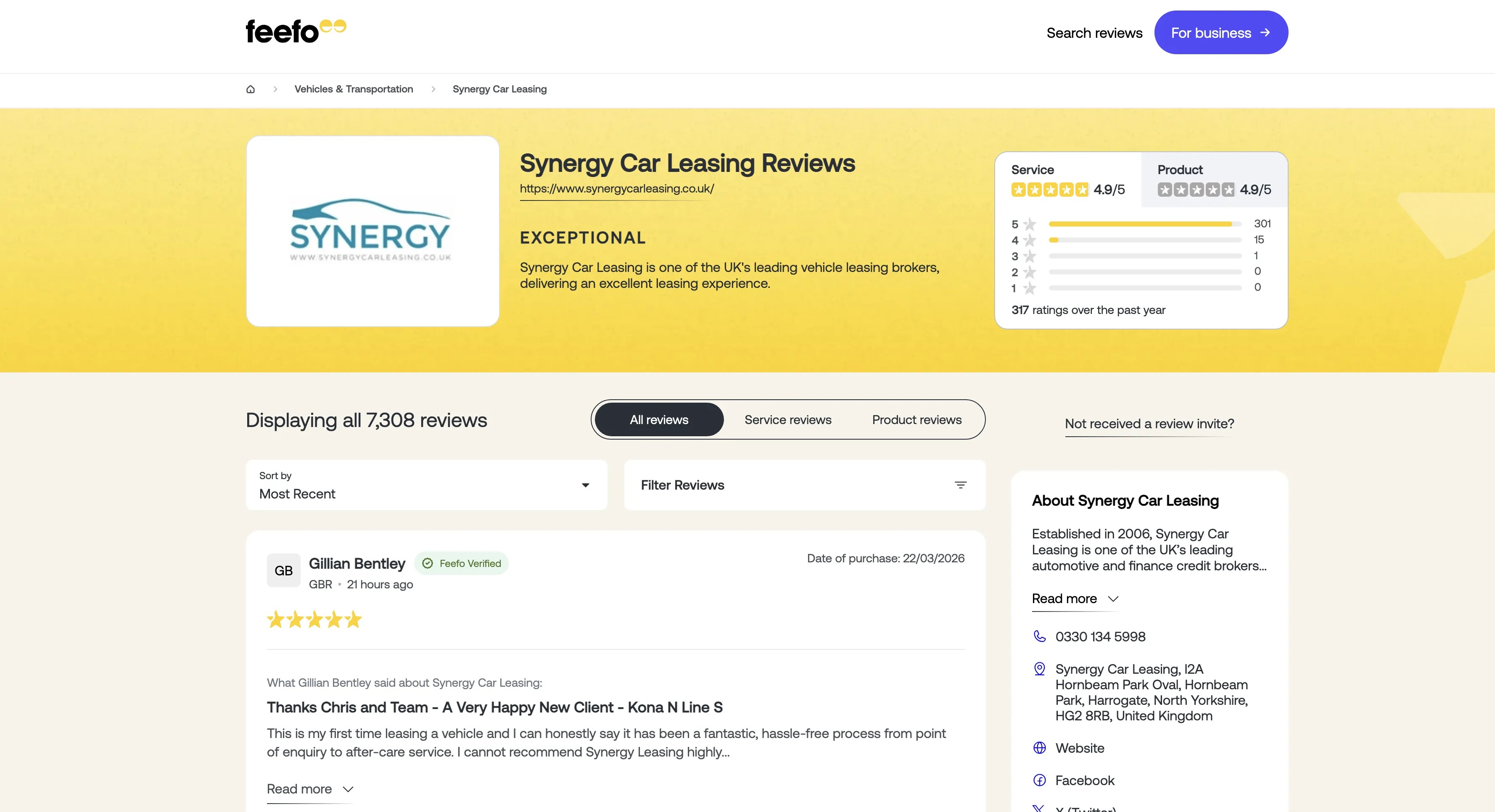
Synergy Car Leasing on Feefo. 7,308 verified reviews with an Exceptional rating across service and product.
Feefo's model is invitation-only; customers can only leave a review after a verified transaction. That means every review is genuine, which carries weight with buyers who've learned to be sceptical of open platforms. For a broker targeting fleet managers or corporate buyers who do their due diligence, a verified review platform can carry more credibility than a higher volume of unverified ones.
The choice between platforms is itself a strategic decision. Trustpilot has broader consumer recognition and stronger SEO benefits (star ratings in Google results, high domain authority passing link equity). Feefo offers verification credibility and integrates well with B2B sales processes. Neither is wrong; the important thing is choosing one and building it systematically.
The broker takeaway
A review strategy isn't optional anymore. It's the difference between a prospect who converts and one who keeps searching. Pick a platform, build a systematic process for requesting reviews after every delivery, and respond to every piece of feedback (positive and negative). The compounding effect is real: the more reviews you have, the more trust you build, the higher you rank, and the easier every subsequent sale becomes. We'll be publishing a detailed comparison of Feefo vs Trustpilot for leasing brokers soon, covering which platform suits which type of business and how to build a review engine that compounds.
What This Means for Independent Brokers
Every brand in this article operates at a scale you probably can't match. That was never the point.
The point is that each one made a choice (about identity, about content, about how they treat people between the order and the delivery) and then they stuck with it long enough for it to compound. The advantage wasn't the budget. It was the commitment.
Before we get to the takeaways, here's where each brand actually sits today. Three dimensions: domain authority (how much trust search engines place in the site), estimated organic traffic (the result of that trust), and the size of their referring domain profile (how many other websites link to them). The bigger the circle, the more sites are linking in.
SE Ranking data · UK market · April 2026 snapshot
Competitive Landscape
Domain authority vs estimated organic traffic. Bubble size reflects referring domains, the number of unique websites linking to each brand.
Hover over a bubble for details. Carwow operates across the full automotive market, not leasing alone, included for context on what a content-led ecosystem looks like at scale.
Domain authority (InLink Rank), organic traffic and referring domains are SE Ranking estimates. The question for independent brokers: where would your brand sit on this chart, and which axis would move fastest with the right investment?
If you take one thing from each:
- From Jurni: make deliberate choices about how you look, sound and feel. Then stick with them. A cohesive brand built on clear decisions will always beat a bigger competitor running on defaults.
- From Select and Nationwide: structure beats volume. Ten pages that interlink with purpose will outrank a hundred that don't know each other exist.
- From Vanarama: invest in being known. Every person who searches your name instead of "car leasing deals" saves you money on every other channel.
- From ZenAuto: put your positioning in your advertising. If your ads only work when you have the lowest price, you haven't got ads; you've got a price list.
- From Carwow: build an audience before you try to sell to it. Content that earns attention first creates a commercial asset that compounds over time, and makes every other channel cheaper.
- From Select and Synergy: treat reviews as a system, not an afterthought. Pick a platform, request feedback after every delivery, and let the compounding effect do the work. Fifty thousand five-star reviews is a competitive advantage no ad budget can buy.
- From Hippo Leasing: the delivery window is your biggest opportunity to earn a five-star review and a referral. Don't waste it with silence.
The brokers who'll still be growing in three years aren't the ones who copied Vanarama's ad spend or replicated Carwow's video format. They're the ones who picked one thing, did it with genuine care, and kept showing up. Week after week. Month after month. Even when the results didn't come immediately.
That's not a marketing strategy. It's a character trait. And it's the one thing your competitors can't copy. If you want a structured framework for putting these principles into practice, our complete marketing strategy guide and growth framework for leasing brokers cover the operational detail.
Ready to build your marketing advantage?
Our Growth Review gives you a structured assessment of where your marketing stands today (across brand, SEO, paid media, conversion and CRM) with a clear roadmap for what to prioritise first. Built specifically for independent leasing brokers.
Learn about the Growth Review →