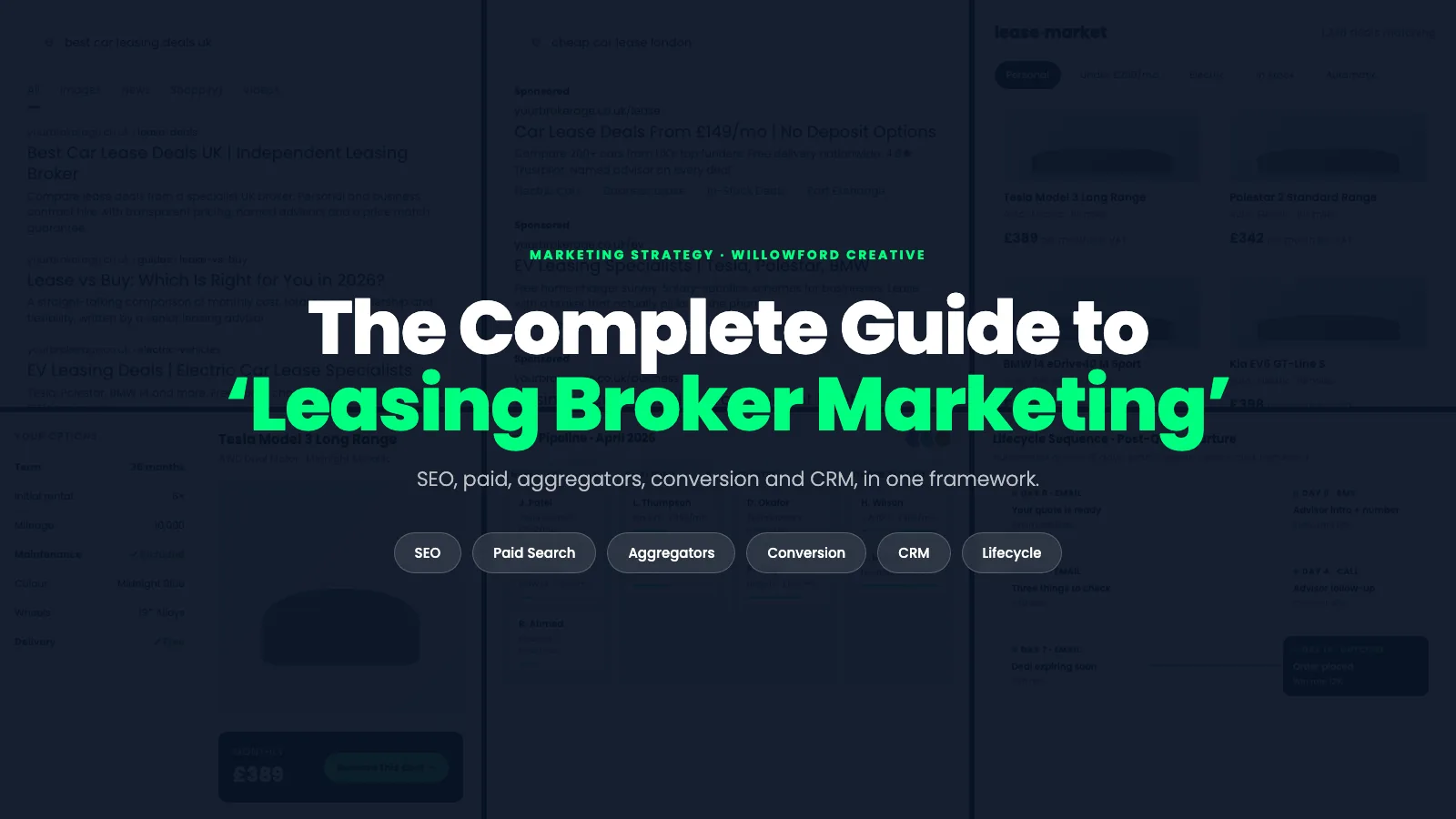
A leasing broker marketing strategy is the structured framework that connects your brand positioning, acquisition channels — organic search, paid media, aggregators — content architecture, conversion process, analytics and CRM lifecycle into a system that compounds growth rather than just consumes budget. Most independent brokers don't have one. They have a collection of disconnected tactics, an aggregator listing, some Google Ads, and a social post when time allows, held together by the hope that the phone keeps ringing.
This guide sets out a framework that's been tried and tested in a real brokerage, one we built from a standing start through to acquisition by one of the UK's leading automotive marketplaces. Along the way, we moved conversion rates from 5% to 15% and reduced cost per acquisition by 85% by building the right channel architecture. If you're an independent broker who wants to stop renting pipeline from aggregators and start building one you own, this is the strategy that works.
Why this guide exists
Everything in this guide comes from direct experience of building and scaling a UK leasing brokerage, from first deal through to acquisition. These are the numbers that shaped the strategy.
The UK leasing broker sector ended 2025 in a strong position. The BVRLA reported the car lease fleet breaking the 1.5 million vehicle barrier for the first time in seven years, with Business Contract Hire growing 7.8% year-on-year and salary sacrifice arrangements rising 118%. The opportunity is real. The question is whether your marketing is structured to capture it, or whether you're handing the margin to platforms that will keep raising their rates.
If your business isn't one of the large nationals with eight-figure marketing budgets, or you're not working within one of the core aggregator platforms themselves, you still have a right to win. You can still build a marketing function that compounds growth rather than just consumes budget.
At a glance
- Strategy, not tactics — most brokers operate without a coherent marketing framework. Tactics without strategy produce activity, not growth.
- Aggregators are a channel, not a strategy — platforms like LeaseLoco and Leasing.com drive volume but commoditise your offer. Heavy reliance is a structural margin problem, not just a cost issue.
- Paid search has a role, but a specific one — Google Ads work for leasing brokers when deployed against high-intent, model-level queries. They fail when used as a substitute for organic growth.
- Organic search is the compounding asset — once built, an organic presence delivers leads at a fraction of the cost of paid or aggregator traffic, with significantly higher intent.
- Brand positioning is upstream of everything — without a clear answer to "why you over anyone else", every marketing channel underperforms.
- Conversion is where most brokers leak revenue — generating traffic is only half the problem. Speed to lead, form design and follow-up discipline determine whether that traffic becomes pipeline.
- You need a commercial analytics layer — tracking lead volume is not enough. Cost per acquisition by channel is the metric that drives better decisions.
- CRM and lifecycle ownership are the compounding moat — brokers who systematically nurture, renew and re-engage their client base build a revenue engine that aggregators cannot replicate.
What this guide covers
- Why most leasing broker marketing strategies underperform
- The core components of a strategy that works
- Brand positioning: competing on something other than price
- SEO for leasing brokers: building a lead channel you own
- Content architecture: how authority compounds over time
- Paid search for leasing brokers: when it works and when it doesn't
- Aggregator strategy: dependency, diversification and the transition to owned channels
- The 2026 market: Chinese OEMs, agency models, and the broker's role
- Marketing analytics: measuring what drives revenue
- Conversion: where most leasing brokers leak revenue
- CRM and lifecycle: turning enquiries into long-term revenue
- What this looks like by growth stage
- Frequently asked questions
Why Most Leasing Broker Marketing Strategies Underperform
The majority of independent leasing brokers operate without a coherent marketing strategy. Whilst at first, a sweeping statement like this might seem a little disparaging, but when you dig a little deeper, it starts to make sense. The average brokerage owner juggles many hats and juggling writing business, delivering orders, managing compliance and handling finances, marketing typically is a, 'we'll get to that' task.
Independent brokers I've worked with usually operate with a collection of understandable tactics; an aggregator listing here, some Google Ads there, a social post when time allows, all held together by the hope that the phone keeps ringing and the orders keep happening. For many brokers, leads can come from many angles and the phone might still ring, but the sources drive the wrong conversations, the margins aren't strong enough and no durable, future-proofed lead generating asset is established in the process.
In my experience, I've seen four structural 'failure modes' that account for most of the underperformance we see:
Aggregator dependency
Listing on LeaseLoco, Leasing.com, Moneyshake and their equivalents will generate enquiries for your business. However, it'll also position your brokerage as one of thirty-plus options on a price comparison table. When you compete primarily through aggregator channels, you compete primarily on price and, inevitably, price competition compresses your margin. Unless you're a big player with big budgets and committed deals, competing is a challenge.
We used aggregator platforms and saw success, but found that these platforms also change their pricing structures regularly. Brokers who built their pipeline almost entirely through aggregators in the last five years have felt impact of rising costs acutely. Dependency is a structural risk, not just a cost consideration.
Weak positioning
If a prospective client visited your website and removed your logo, could they tell you apart from any other broker? For most, the honest answer is no. The same stock imagery, the same "best deals" promise, the same generic contact form. Considering your positioning is your strategic approach to delivering a specific and credible answer to "why you over anyone else". It should be the anchor to every marketing decision because, without it, you won't be able to establish brand loyalty (a tough gig in the leasing space at the best of times), and without loyalty, every channel won't perform to the fullest...because there's no unique message to amplify.
Wrong metrics
Lead volume is the KPI most brokers reach for first, and it is one of the most misleading numbers in the business. A channel producing cheap leads is not necessarily producing profitable ones. The metric that should anchor marketing decisions is cost per acquisition. The best leasing brokers take this one step further and measure cost per acquisition by channel...what it actually costs you to write a piece of business from each traffic source.
Most brokers either lack this data or haven't connected it to channel performance, which result in budget being allocated by gut feel rather than by commercial evidence. We cover this in depth in our guide to the KPIs independent leasing brokers should actually be tracking.
No owned pipeline
CRM adoption in the independent broker sector remains low and, frankly, a missed opportunity to drive down cost per acquisition. Brokers who don't systematically capture, nurture and follow up with enquiries (and who don't build a client database they can communicate with over time) are leaving repeat and referral business on the table. Repeat clients typically cost a fraction of what new acquisition costs and are easier to close because a relationship is already established. Referral clients also convert at a higher rate and require less price justification because third party trust is delivered via the referrer. Neither appears in an aggregator dashboard.
The Core Components of a Leasing Broker Marketing Strategy
A functioning leasing broker marketing strategy has several interlocking components. They're not sequential, you don't complete one before starting the next, but they are interdependent. Weakness in any one of them limits the performance of the others.
The core components are:
- Brand positioning — the strategic foundation that every channel builds on
- Organic search presence — the compounding lead channel you own
- Content architecture — the structure that turns publishing into authority
- Paid search — the complement to organic for high-intent capture
- Aggregator strategy — managing platform channels without becoming dependent on them
- Commercial analytics — the measurement layer that turns gut feel into evidence
- Conversion — the operational discipline that turns traffic into pipeline
- CRM and lifecycle — the infrastructure that compounds client value over time
Each is explored in detail below.
Brand Positioning: Competing on Something Other Than Price
Positioning is the strategic decision about what your brokerage stands for and who it's for.
It's not a tagline.
It's not a values statement.
It's a specific, defensible answer to the question a prospective client asks when they are choosing between you and three other brokers: why you?
The independent broker has a structural advantage here that the large nationals and aggregator platforms don't. You can be specific in a way they simply can't.
For example, Vanarama couldn't credibly position as the expert in fleet leasing for owner-managed SMEs as they span too much of the wider market. Select Car Leasing couldn't reasonably position as the specialist for EV salary sacrifice for professional firms because they inhabit so much of the wider leasing space. You can, and that specificity is what converts.
In our experience, a "muddy" brand is a slow-death brand. The brokers we've seen grow fastest made a deliberate choice early on about what they wanted to be known for. Not what they could do, but what they wanted to be the obvious answer for. That choice falls into one of three strategic anchors, and it should shape everything from your website's user flow to your content strategy and ad copy.
Choose your strategic anchor
Salary sacrifice specialist
Your website leads with B2B tax-saving education, employer case studies, and BIK calculators. Your content speaks to HR directors and finance leads. Your enquiry flow captures company size and fleet interest, not just vehicle preference.
BCH fleet partner
Your site emphasises fleet transition planning, multi-vehicle quoting, and funder depth. Your content targets procurement leads and business owners. Your CRM is structured around account management, not transactional deal flow.
PCH volume brand
Your site prioritises live stock, fast configuration, and deal speed. Your content focuses on model comparisons, monthly cost breakdowns, and "best deals this month" formats. Your conversion path is short: browse, configure, enquire.
The choice matters because your website's user flow, your content calendar, and your paid search campaign structure all need to reflect it. A salary sacrifice specialist running generic PCH Google Ads campaigns is wasting budget. A PCH volume brand publishing fleet transition whitepapers is talking to the wrong audience. The strategic anchor doesn't mean you can't serve other segments, but it determines where you lead.
Effective positioning for an independent leasing broker typically has three elements:
Audience specificity
Who do you serve best? Fleet clients or personal? Do you (or could you) service specific sectors like healthcare, legal, tech? Are you a business that focuses on high-value business contract hire or volume personal leasing? The brokers building durable margin aren't trying to be the right answer for everyone from day one. The big brands secured a foothold in an area first, then expand.
Demonstrable expertise
What do you know that competitors don't, or won't be able to articulate as well? For example, do you bring expertise on fleet EV transition planning? Do you have market-leading knowledge in navigating complex salary sacrifice schemes? Do you have a genuine track record in a specific vehicle category?
Expertise is more than a strapline. It's what you demonstrate through content, case studies and the quality of your advice.
A client experience that is meaningfully better
In a market where most brokers look indistinguishable online, the quality of the enquiry-to-order experience is a genuine differentiator. Response time, communication, proactive advice, post-delivery follow-up...These are things a large national can't deliver consistently (Just filter one star reviews on TrustPilot for the biggest brands and you'll see these are the consistent themes popping up).
An independent broker who prioritises customer experience builds the kind of word-of-mouth referral network that reduces new acquisition cost over time. That's where it counts.
Establishingy our brand position requires the honest answers to the following three questions:
Who are your best current clients?
What do they value about working with you?
Can you build your marketing around attracting more of them?
SEO for Leasing Brokers: Building a Lead Channel You Own
Organic web traffic...the traffic that arrives from Google and other search engines without you paying per click...is the most commercially valuable channel available to an independent leasing broker.
It's also the most under-invested.
Businesses under-investment for predictable and, on the surface at least, perfectly understandable reasons.
Organic search takes time to build and the results aren't immediate.
Paid channels and aggregators produce enquiries today which immediately feeds the bottom line; organic (otherwise known as search engine optimisation (SEO)) produces enquiries in six to twelve months.
For a broker managing a busy pipeline, investing in something that doesn't produce a return this quarter is difficult to prioritise. That said, this is precisely why brokers who do invest in organic presence are able to build a durable competitive advantage. It's not a channel that's easy establish quickly, and as such, it's hard to replicate. A competitor who starts an SEO programme today will not displace you in the next three to six months and, so long as you continue your efforts, you have the opportunity to always step ahead.
Perhaps more important, organic lead quality is also consistently higher, in my experience converting at 5-10% more, with great margins too. This is because someone who searched specifically for a broker, found your site and made an enquiry has significantly more intent than someone scrolling an aggregator price table.
The data from the UK sector bears this out. Clickthrough Marketing's benchmarking research on UK leasing brokers found that the top performers for organic visibility, Select Car Leasing and Nationwide Vehicle Contracts, had built significant content depth alongside their technical SEO infrastructure. Select Car Leasing, the sector leader for organic search, had accumulated approximately 27,000 words of content across 627 pages. That's not accidental. It's the result of sustained, deliberate investment.
For an independent broker, you don't need to match that scale. You simply need to be the authoritative answer for the specific queries your best clients are searching. That's a more achievable goal, and it becomes even more attainable each time you publish a genuinely useful piece of content that a competitor hasn't bothered to write. For a closer look at what the top of the "car leasing" SERP actually gets right, see our SEO and CRO teardown of five leading UK leasing brands.
The foundation of organic performance is covered in our guide to content architecture for leasing brokers.
Content Architecture: How Authority Compounds Over Time
As nice as it would be, publishing a single article won't move the needle whenit comes to establishing organic search presence. You need to establish topical authority, the accumulated signal to Google that your website is a genuine, comprehensive resource on a given subject. That requires a structured approach to content, not a sporadic publishing schedule because you've got five minutes spare.
Establishing a solid content architecture as a leasing broker is key. It allows you to organise your articles and pages around a set of core topics, known as pillars, each of which is supported by a set of more specific articles, known as clusters, that link back to the pillar.
The pillar article you're reading right now is an example: it covers leasing broker marketing strategy as a broad topic, and links out to more specific guides on KPIs, content, social media and CRM. Each of those linked articles reinforces the pillar's topical authority, and each benefits from the authority of the pillar in return.
The practical result of this structure is its compounding effect. Articles published today will rank for queries next quarter. Queries ranked next quarter will attract links and citations that improve rankings further. A well-structured content architecture, maintained consistently over twelve to eighteen months, produces a lead channel that operates at minimal cost per acquisition.
The articles that drive the most value are not the ones with the broadest topics. "Car leasing UK" is, dare I say it, an unwinnable keyword for an independent broker. "Fleet leasing advice for owner-managed SMEs" or "EV salary sacrifice broker UK" are winnable, abeit competitive, and they attract exactly the type of client worth writing business with.
Key principles for leasing broker content strategy:
- Answer the primary search query directly in the first 150 words. Google's AI overviews and featured snippets reward this, and it signals to human readers immediately that they are in the right place.
- Write for the specific client you want to attract, not a generic "anyone interested in leasing". Specificity improves both search performance and enquiry quality.
- Publish on a consistent cadence. Even one valuable article per month, published reliably, compounds meaningfully over two years. Sporadic publishing does not.
- Internal link deliberately. Every article should link to at least two or three related pieces. This distributes authority across the site and signals topical depth.
Our article on social media marketing for leasing brokers covers how organic content and social distribution work together to build pipeline. Our analysis of the IAB's reclassification of creator marketing as a 'core media channel' covers what the broader channel-mix shift means for independent brokers. Our guide to the leasing broker technology stack covers the tools that support content publishing and tracking at scale.
Paid Search for Leasing Brokers: When It Works and When It Doesn't
Paid search — primarily Google Ads — is a core acquisition channel for leasing brokers. It's also one of the most frequently misused. The brokers who get value from paid search treat it as a precision tool for capturing high-intent demand. The brokers who waste money on it treat it as a substitute for building organic visibility.
The distinction matters because the economics of paid search in the leasing sector are unforgiving. Generic terms like "car leasing" or "best lease deals" carry high cost per click and attract browsers, not buyers. The cost per acquisition on these terms is typically prohibitive for an independent broker competing against nationals with significantly larger budgets. Bidding on broad terms against Vanarama or LeaseLoco is not a fight most independents can win profitably.
Where paid search does work, and works well, is on specific, high-intent queries where organic ranking is not yet achievable. Our dedicated guide to Google Ads for leasing brokers covers campaign structure, brand vs non-brand strategy, budget allocation and the metrics that actually matter in detail.
Brand vs non-brand
Brand campaigns — bidding on your own business name — are low-cost, high-conversion and protect you from competitors bidding on your name. Every broker running paid search should have a brand campaign active. The cost is marginal and the downside of not running one is losing clicks you've already earned through brand awareness.
Non-brand campaigns are where the strategic decisions get harder. The principle is specificity: the more specific the query, the higher the intent and the lower the competition.
Model-level and niche bidding
The highest-performing paid search campaigns for leasing brokers target specific vehicles and use cases. "BMW 3 Series lease deals" has significantly higher purchase intent than "car leasing UK". "Electric van lease for small business" attracts a prospect who knows what they want and is closer to converting.
This is where an independent broker's positioning advantage shows up in paid search as well. If your brokerage specialises in EV salary sacrifice, bidding on those specific queries will produce better cost per acquisition than a generalist campaign ever could — because your landing page, your expertise and your follow-up are all aligned to that specific need.
The margin question
The metric that governs paid search investment is not cost per lead — it's cost per acquisition measured against the margin on the deal. A lead that costs £40 but converts at 12% on a deal with healthy margin is a good investment. A lead that costs £15 but converts at 2% on a commoditised deal is not, even though the cost per lead looks attractive.
This is why paid search and commercial analytics are inseparable. Without channel-level cost per acquisition data, you cannot make informed decisions about which campaigns to scale and which to pause. Our guide to the KPIs independent leasing brokers should actually be tracking covers how to build this measurement layer.
The decisive deal advantage
Budget isn't everything in paid search. Agility matters just as much, sometimes more. I've seen independent brokers outperform nationals with ten times the budget simply by being faster to market with a tactical deal.
Here's a real example. When a particular Tesla Model Y configuration dropped to a price point that made it genuinely competitive, the brokers who spotted it early, built a landing page the same day, and pushed a targeted Google Ads campaign against "Tesla Model Y lease deals" that afternoon captured the first wave of search demand before the larger competitors had even updated their stock feeds. Low configuration time, high decisiveness.
Pro tip
Inquisitiveness and speed to market are a broker's greatest marketing assets. Build a workflow for tactical deal campaigns: spot the deal, build the landing page, launch the ad, capture the demand. The brokers who can do this in under 24 hours have a structural advantage that no SEO budget can replicate.
Paid search as a bridge, not a foundation
The most effective way to use paid search as an independent broker is as a bridge: covering high-value queries with paid while your organic content programme builds toward ranking for them naturally. As organic rankings improve, paid spend on those terms can be reduced or reallocated to the next set of target queries. This creates a deliberate cycle where paid funds the gap that organic hasn't yet filled, and the overall cost per acquisition declines over time as organic takes over.
Brokers who treat paid as their primary channel without investing in organic are building a marketing function with no compounding effect. Every lead costs the same next month as it does this month. That's a rental model, not a growth model.
Aggregator Strategy: Dependency, Diversification and the Transition to Owned Channels
Aggregator platforms — LeaseLoco, Leasing.com, AutoTrader leasing, Moneyshake and their equivalents — are a significant part of the UK leasing broker landscape. Most independent brokers use at least one, and many generate a meaningful proportion of their pipeline through them. The question is not whether to use aggregators. It's how to use them strategically, without allowing them to become the foundation your business depends on.
What aggregators do well
Aggregators provide immediate volume. For a new or growing brokerage, they offer access to a stream of enquiries that would take months or years to build through organic channels alone. They carry established domain authority and consumer trust, and for brokers who don't yet have significant brand recognition, they provide a route to market that works from day one.
They also provide useful market signal. The enquiries you receive through aggregators tell you which vehicles, terms and price points are generating demand — data that can inform your content strategy and paid search targeting.
The structural risks
The problems with aggregator dependency are well understood but worth stating clearly, because they compound over time.
Margin compression. When your listing sits alongside thirty other brokers on a price comparison table, the conversation defaults to price. This compresses margin on every deal and makes it harder to compete on service, expertise or relationship — the things that actually differentiate an independent broker.
Platform pricing risk. Aggregator platforms adjust their fee structures regularly. Brokers who built their pipeline primarily through aggregators over the last five years have experienced this directly: the cost of the same lead today is materially higher than it was three years ago. A channel whose cost you don't control is a channel that can erode your margin without warning.
Brand invisibility. On an aggregator, the customer's relationship is with the platform, not with you. They are comparing your price against competitors they found on the same page. Repeat business and referral from aggregator-sourced clients is structurally lower than from clients who found you directly, because the brand association is weaker.
Data limitation. Aggregator dashboards show you enquiry volume and, in some cases, conversion rates. They don't show you the lifetime value of the client, the referral potential, or the true cost per acquisition once your operational costs are factored in. Without connecting aggregator data to your own CRM, you're making channel decisions with incomplete information.
A practical approach to diversification
The transition away from aggregator dependency is not about switching off a channel that is currently generating revenue. It is about gradually shifting the balance of your pipeline toward sources you own and control.
Stage 1 — Measure the true cost. Calculate cost per acquisition for aggregator traffic separately from organic, paid and referral. Factor in platform fees, your team's time spent on lower-conversion aggregator leads, and the margin on aggregator-sourced deals versus direct deals. Most brokers who do this for the first time discover that aggregator cost per acquisition is significantly higher than assumed.
Stage 2 — Build owned channels in parallel. Start a content programme. Optimise your Google Business Profile. Run targeted paid search on high-intent queries. Ensure your website is technically sound and converts well. These are not immediate revenue drivers — they are infrastructure investments that pay out over twelve to twenty-four months. The brokers who started this work in 2023 are now seeing meaningful organic traffic that costs them almost nothing per enquiry.
Stage 3 — Shift the mix deliberately. As organic, paid and referral traffic grows, the margin freed from reduced aggregator spend can be reinvested into the content and CRM infrastructure that accelerates the shift further. This is the compounding effect in practice: lower acquisition cost from owned channels funds more investment in those channels, which further reduces acquisition cost over time.
This is not a rapid transformation. It is a deliberate, multi-year strategic choice. The brokers making that choice now are building the kind of durable business that will not be held hostage to the next platform pricing change.
The 2026 Market: Chinese OEMs, Agency Models, and the Broker's Role
The UK leasing market in 2026 looks materially different from even two years ago, and your marketing needs to reflect that.
The Chinese OEM wave
BYD, OMODA, JAECOO, Xpeng, and others have moved from curiosity to genuine market presence. Consumer awareness of these brands is growing but understanding remains low. Most prospective customers have questions they can't get answered from a manufacturer website: How reliable are they? What's the residual value picture? How do they compare on a monthly payment basis to established marques?
This is a genuine content and positioning opportunity for brokers. The information asymmetry between what you know about these vehicles (funder appetite, residual value positions, real-world feedback) and what the average consumer understands is substantial. Brokers who position themselves as the "neutral guide" to new Chinese badges, with honest, experience-led content, are building trust and pipeline in a space that the larger nationals haven't prioritised yet.
The window where this is relatively uncontested won't stay open indefinitely.
Agency vs wholesale model confusion
The shift from wholesale to agency distribution models by manufacturers like Mercedes-Benz, alongside the continued wholesale approach from brands like Volkswagen, has created genuine consumer confusion. Many buyers don't understand why they can negotiate on one brand but not another, or why pricing structures differ so significantly between marques.
For leasing brokers, this confusion is an opportunity to position as the one place where a customer can compare all options fairly, regardless of manufacturer distribution model. Content that explains these differences clearly, without manufacturer bias, signals genuine expertise and builds the kind of trust that converts.
Action step
Audit your current content and website. Do you have pages that address Chinese OEM leasing? Do you explain the agency vs wholesale difference anywhere? If not, these are immediate content opportunities with genuine search demand and minimal competition. The broker who publishes the definitive "BYD lease guide" or "agency model explained" piece first will own that organic traffic for months.
Marketing Analytics for Leasing Brokers: Measuring What Actually Drives Revenue
Most leasing broker marketing sits in a measurement vacuum. Enquiries come in, orders get written, and the connection between the the channel, the source, and the campaign remains opaque. This isn't a data problem, it's a decision-making problem: without channel-level cost per acquisition data, marketing investment decisions are made by instinct rather than evidence.
Uninformed decision-making erodes margin.
The commercial analytics layer a leasing broker needs is not complex. It has three parts:
Goal tracking in Google Analytics 4
Set up conversion events for enquiry form submissions, phone call clicks, and any other primary conversion actions on your site. This is free, takes a few hours to configure correctly, and transforms what you can see about performance.
Source attribution in your CRM
When an enquiry arrives, capture how it arrived — organic search, Google Ads, aggregator, referral, direct. Even rough attribution is better than none. When you connect CRM data to GA4 source data, you can calculate cost per enquiry and, over time, cost per acquisition by channel.
Regular channel-level review
Once a month, look at cost per acquisition by channel, not blended across the business, but split by source. This single habit changes how you allocate budget. It reveals which channels are producing profitable business and which are producing activity without margin.
The golden metric: CPA per channel per consultant
If you want to take this one step further, and I'd encourage every broker writing more than 50 deals a month to do so, track cost per acquisition by channel and by consultant. This gives you tactical intelligence that most brokerages never access.
In practice, you'll find that certain consultants convert specific lead types at dramatically different rates. One consultant might be a BCH specialist who closes fleet enquiries at twice the rate of the team average. Another might excel at high-volume PCH from aggregator traffic. When you can see this data clearly, you can route leads to the consultant most likely to convert them, improving both conversion rate and consultant satisfaction.
This is the kind of operational intelligence that turns a marketing budget from a cost centre into a precision tool.
Pro tip
The platforms that support this level of tracking for leasing brokers include Motorcomplete, Automotus, and QV Systems, each offering CRM and lead management built specifically for the automotive intermediary space. A generic CRM like HubSpot can do it too, but requires more configuration. The key is choosing a system where lead source, consultant assignment, and deal outcome are connected in a single reporting view.
Compliance as a marketing asset
This is counterintuitive, but FCA compliance, specifically Consumer Duty, is a genuine marketing differentiator for brokers who frame it correctly. Most brokers treat compliance as a cost of doing business. The smart ones use it as a trust signal.
Publishing your Fair Value assessment, being transparent about commission structures, and clearly communicating how you meet Consumer Duty requirements on your website all signal credibility to a prospect who has been burned by opaque pricing elsewhere. In a market where consumer trust in financial intermediaries remains fragile, transparency is not just regulatory hygiene. It's a competitive advantage. Our guide to FCA financial promotions rules for leasing brokers covers exactly what every promotion needs to include, from commission disclosure to credit broker status.
The detail behind this framework is in our guide to the KPIs independent leasing brokers should actually be tracking. The question of speed of response, one of the most undervalued conversion variables in the sector, is covered in our article on speed to lead for leasing brokers.
Not sure where your biggest marketing lever is? A Growth Review gives you a clear, commercially grounded picture of your channel economics, conversion gaps and where the next stage of growth is hiding.
Book a Growth Review →Conversion: Where Most Leasing Brokers Leak Revenue
Generating traffic — whether through organic search, paid media or aggregators — is only half the problem. The other half is converting that traffic into enquiries and converting those enquiries into written business. This is where most leasing brokers leak the most revenue, often without realising it.
Conversion rate optimisation for a leasing broker is not about A/B testing button colours. It's about the operational and structural decisions that determine whether a prospect who lands on your site or submits an enquiry actually becomes a client.
Speed to lead
Response time is the single most undervalued conversion variable in the leasing broker sector. Research consistently shows that the probability of qualifying a lead drops dramatically after the first fifteen minutes. A broker who responds within five minutes is significantly more likely to connect with the prospect than one who responds within an hour — by which point the prospect may have already spoken to a competitor.
This is not a customer service issue. It is a revenue variable. The difference between a thirty-minute average response time and a two-hour average can represent tens of thousands of pounds in lost deals per year for a mid-sized brokerage. Our detailed guide on speed to lead for leasing brokers covers the research, the benchmarks and the three operational changes that make the biggest difference.
Real-world snapshot
The two-consultant test. I've seen this pattern in more than one brokerage: two consultants receive the same lead mix from the same sources. Consultant A closes 75% of their leads as "uncontactable" or "not interested". Consultant B reaches 75% of the same quality leads and converts at a healthy rate. Same leads. Same CRM. Completely different outcome. The difference was almost never lead quality. It was operational approach: multi-channel persistence (phone, SMS, WhatsApp, email), speed of first contact, and the willingness to try a second and third touchpoint before writing a lead off. Marketing value is wasted without this operational layer. Before you blame the lead source, audit the handling.
Enquiry form and landing page design
The structure of your enquiry forms and landing pages directly affects how many visitors convert into leads. Common mistakes include: asking for too much information upfront (which creates friction), burying the enquiry form below the fold, and using generic calls to action that give the prospect no reason to act now.
Effective landing pages for leasing brokers typically share three characteristics: they answer the specific query the visitor searched for, they present a clear and low-friction next step (a short form, a phone number, or both), and they include trust signals — reviews, accreditation, or specific evidence of expertise — that reduce the perceived risk of making contact.
Follow-up discipline
The gap between sending a quote and following up is where the majority of convertible deals are lost. A prospect who has received a quote and gone quiet has not necessarily decided against you. They may be comparing options, waiting for a decision-maker, or simply busy. A structured follow-up sequence — timed, consistent and professionally delivered — recovers a meaningful proportion of these deals.
Our leasing broker follow-up framework covers the full sequence from first response through to renewal, including what to send, when to send it, and where most brokers lose deals in the process.
Channel-specific conversion thinking
Not all traffic converts equally, and the conversion approach should reflect the source. A visitor who arrived via organic search for a specific query has high intent and typically needs a clear, relevant landing experience. A visitor from an aggregator has already been comparing prices and needs a reason to choose you beyond cost. A referral arrives with pre-existing trust and often needs less persuasion but still benefits from a responsive, professional process.
Understanding these differences and structuring your website and follow-up accordingly is what separates brokers who convert at 5% from those who convert at 15%. The analytics framework covered earlier in this guide provides the data to see these patterns; the conversion layer is where you act on them.
CRM and Lifecycle: Turning Enquiries into Long-Term Revenue
A CRM — customer relationship management system — is not administration software. It is the infrastructure that converts a list of past enquiries into a compounding commercial asset. For leasing brokers specifically, where the average contract cycle is two to four years, the lifetime value of a well-managed client relationship is substantial — and the cost of losing that client to a competitor at renewal is one of the most expensive and least visible leaks in the business.
The average leasing broker has more potential business sitting dormant in their email history than they are actively working at any given time. Clients whose contracts are approaching renewal. Enquiries that didn't convert last quarter but might convert this one. Referrals that were promised but never followed up. A CRM captures these relationships and creates the system to act on them.
The foundations
At minimum, a leasing broker CRM should do the following:
- Record every enquiry with source, contact details and initial vehicle interest
- Track the status of every active deal through to completion
- Flag contracts approaching renewal for proactive outreach
- Support a structured follow-up sequence for unconverted enquiries
- Capture source attribution so you can connect channel spend to deal outcomes
Lead nurture sequences
Not every enquiry converts immediately. In leasing, the consideration period can stretch from days to months depending on the client's contract timeline, budget cycle or fleet planning process. Brokers without a nurture system lose these prospects to competitors who simply stayed in contact.
A basic nurture sequence for unconverted leasing enquiries typically includes: a follow-up within 24 hours of the initial quote, a check-in at day three, a value-add touchpoint at week two (market insight, deal alert or relevant content), and a periodic re-engagement over the following months. The goal is not to pressure — it's to remain present and helpful so that when the prospect is ready to move, you are the broker they think of first.
Renewal and retention
The most commercially valuable function of a leasing broker CRM is contract renewal management. A client whose contract expires in six months is the highest-quality lead in your database: they already trust you, they already have a relationship with you, and the cost of retaining them is a fraction of acquiring a new client.
Brokers who start the renewal conversation six months before contract end — with a proactive, personalised approach — retain significantly more business than those who leave it until the last month and hope the client comes back. A CRM with contract end dates, automated reminders and a structured renewal sequence turns this from a reactive hope into a systematic process.
Referral and re-engagement
Systematically asking satisfied clients for referrals is one of the lowest-cost, highest-quality lead generation methods available to a leasing broker. Referral clients arrive with pre-existing trust, require less price justification and convert at a meaningfully higher rate. A CRM makes this systematic rather than sporadic: trigger a referral request after successful delivery, follow up with clients who've expressed satisfaction, and track which clients are generating introductions.
Re-engagement — reaching back out to lapsed enquiries or past clients who didn't renew — is similarly underused. A prospect who didn't convert twelve months ago may now be in a different position. A former client who went elsewhere may be open to returning. These are low-cost, high-intent contacts that most brokers ignore because they don't have the system to surface them.
The commercial case is straightforward. A client retained is worth significantly more than a new client acquired. This is the competitive moat an independent broker can build that an aggregator platform cannot. LeaseLoco can drive volume. It cannot build a client relationship on your behalf.
The strategic case for CRM adoption is covered fully in our article on the fractional CMO model for leasing brokers, which addresses how brokers at different growth stages approach marketing infrastructure. Our guide to the leasing broker technology stack covers the specific CRM tools that work well for independent brokers.
How marketing channels compare for leasing brokers
| Channel | Cost per lead | Lead quality | Time to results | Compounds? |
|---|---|---|---|---|
| Aggregators | High (rising) | Low to medium | Immediate | No |
| Google Ads | Medium to high | Medium to high | Immediate | No |
| Organic search (SEO) | Low (once built) | High | 6 to 12 months | Yes |
| Referral | Very low | Very high | Ongoing | Yes |
| Email / CRM nurture | Very low | High | 3 to 6 months | Yes |
The brokers building durable margin are the ones shifting spend progressively from the top two rows toward the bottom three. That shift doesn't happen overnight, but the economics make it worth starting now.
What a Leasing Broker Marketing Strategy Looks Like by Growth Stage
Marketing priorities change as a brokerage grows. The right focus for a broker writing 20 deals a month is different from one writing 200. Our dedicated guide on how to grow a leasing brokerage covers this in full. Here is a rough framework by stage:
Early stage (under 30 deals/month). At this stage, referral is the highest-leverage channel. Every satisfied client is a marketing asset. Invest time in delivering an exceptional post-sale experience, asking for referrals systematically, and building your Google Business Profile presence. Start a basic content programme — even a handful of well-written articles aimed at your target client will compound over time. Aggregators may be necessary for volume at this stage, but track their true cost from the start. Do not over-invest in paid media until you understand your conversion economics. Get your speed to lead under fifteen minutes — this single operational discipline will improve your conversion rate more than any channel change.
Growth stage (30–100 deals/month). At this stage, you have enough volume to start seeing meaningful channel-level data. Implement proper goal tracking in GA4. Start connecting CRM data to source attribution. Your content programme should be producing consistent output. Paid search can supplement organic at this stage, but only for high-intent, model-level queries where organic ranking is not yet achievable — not as a substitute for building owned pipeline. Begin actively managing your aggregator mix: measure cost per acquisition by platform and start reducing spend on platforms where the economics don't hold. Implement a structured follow-up sequence and CRM-based nurture for unconverted leads.
Scaling stage (100+ deals/month). At this stage, brand positioning becomes increasingly important. The volume of inbound enquiries makes it easy to take anything that comes in — but the strategic question is what kind of business you want to be writing. Organic traffic should be a meaningful proportion of your pipeline. CRM should be actively generating renewal, referral and re-engagement revenue. Paid search should be operating as a precision tool for specific gaps, not a volume driver. Aggregator dependency should be reducing quarter by quarter. Conversion rate optimisation becomes a significant lever: at this volume, a one-percentage-point improvement in conversion rate is worth more than a marginal increase in traffic. Marketing investment decisions should be driven entirely by channel-level cost per acquisition data.
Frequently Asked Questions
How much should a leasing broker spend on marketing?
There is no universal answer, but a useful starting benchmark is 3–5% of gross revenue for a growth-stage broker. More important than the absolute figure is how it is allocated: marketing spend on channels with known, measured cost per acquisition is categorically different from spend on channels where you are guessing at the return. Build the measurement infrastructure before you scale the spend.
Is paid search worth it for a leasing broker?
Yes, when used strategically. Paid search works best for specific, high-intent queries — particular vehicle models, niche fleet terms, EV salary sacrifice — where organic ranking is not yet achievable. The key is specificity: model-level and use-case-specific campaigns consistently outperform broad generic terms where cost per click is prohibitive for independents. Always measure cost per acquisition against deal margin, not just cost per lead. The most effective approach is to use paid as a bridge while your organic content programme builds toward ranking for those terms naturally. Our paid search section covers this in detail.
How do I know if my marketing is working?
If you cannot answer the question "what is my cost per acquisition from organic search versus aggregators versus paid?" then you don't yet know. That is the number to build toward. Until you have it, use enquiry-to-order conversion rate by channel as a proxy — it will at least reveal which sources are producing quality versus volume. Our full guide to leasing broker KPIs covers how to build this data layer from scratch.
Should I use social media as a leasing broker?
Social media is a distribution and trust-building channel, not a primary lead generation channel — at least not at the scale most brokers can invest. LinkedIn is the most useful platform for brokers targeting fleet and business clients. The right approach is to use social to distribute useful content, build credibility with your target audience, and generate the kind of brand familiarity that makes a cold enquiry feel slightly less cold. Our detailed guide to social media marketing for leasing brokers sets out what actually works by platform.
What is a fractional CMO and do I need one?
A fractional CMO is a senior marketing strategist who works with your business part-time, typically one or two days per week. For a broker at growth stage who needs marketing leadership but not a full-time hire, it is often the most cost-effective way to build proper marketing infrastructure. We cover the model in full, including when it makes sense and when it doesn't, in our article on the fractional CMO for leasing brokers.
Do I really need a CRM?
Yes, once you are writing more than 20 to 30 deals a month. Below that threshold, a disciplined spreadsheet can serve you. Above it, the volume of client relationships, renewal dates and unconverted enquiries makes it practically impossible to manage without dedicated tooling. The cost of a good CRM is marginal compared to the revenue it protects.
Should leasing brokers use aggregator platforms like LeaseLoco and Leasing.com?
Aggregators have a legitimate role in a leasing broker's channel mix, particularly for newer brokerages that need volume while building owned channels. The risk is dependency, not usage. Aggregator-sourced leads typically convert at lower rates, generate lower margin and build no lasting brand relationship. The strategic approach is to use aggregators deliberately — track their true cost per acquisition separately from other channels, understand which platforms deliver the best economics for your business, and invest the margin differential into organic search, content and CRM infrastructure that compounds over time. Our aggregator strategy section covers the full framework for managing this transition.
How can leasing brokers improve their conversion rate?
Conversion rate improvement for leasing brokers typically comes from three areas: speed to lead (responding to enquiries within fifteen minutes rather than hours), structured follow-up sequences (systematic, timed contact rather than ad hoc chasing), and landing page and form optimisation (reducing friction in the enquiry process). Of these, speed to lead usually delivers the largest immediate uplift. Our articles on speed to lead and the leasing broker follow-up framework cover the operational detail.
How do leasing brokers get leads?
Leasing brokers typically generate leads through a mix of aggregator platforms (LeaseLoco, Leasing.com, Moneyshake), Google Ads, organic search, referrals and direct enquiries. The best-performing brokers build channel depth rather than relying on any single source. Aggregators provide immediate volume but at high cost and low margin. Paid search captures high-intent demand for specific vehicles and use cases. Organic search and referral channels take longer to build but deliver higher-quality enquiries at a fraction of the cost. The brokers scaling sustainably are the ones shifting their mix progressively toward owned channels while optimising conversion at every stage. Our guide on how to grow a leasing brokerage covers this in detail.
Is SEO worth it for leasing brokers?
Yes, and it's increasingly the difference between brokers who scale profitably and those who stay dependent on aggregators. Organic search delivers leads with higher intent, because someone who searched for your specific offer and found your site is further along the decision process than someone browsing a price comparison table. The upfront investment is time and consistency rather than budget: one to two well-written articles per month, aimed at the specific queries your best clients are searching, compounds meaningfully over twelve to eighteen months. For independent brokers, the keyword opportunity in areas like fleet leasing, EV salary sacrifice and specific vehicle categories remains significantly underserved. Our article on content architecture for leasing brokers covers how to structure this effectively.
The Takeaway
A leasing broker marketing strategy is not a single project. It is a set of interconnected systems — positioning, organic search, content, paid media, aggregator management, analytics, conversion and CRM lifecycle — that build on each other over time. The brokers who invest in this infrastructure now are building a compounding commercial advantage. Those who stay entirely dependent on aggregator volume and untracked paid spend are building a business that gets more expensive to run with every platform pricing review.
The UK leasing market is growing. The question is not whether there is opportunity — there clearly is. The question is which brokers will capture it on their own terms, at sustainable margin, with a client base they own and relationships they control.
Want an honest assessment of where your marketing stands?
A Growth Review covers your current channel mix, conversion economics and organic opportunity — and tells you exactly where the leverage is.
Book a Growth Review →