Most independent leasing brokers know they should be investing in SEO. Very few have done it properly, nor how to do it properly. The advice available online is either too generic to apply to the leasing sector, or too technical to action without a dedicated marketing team or agency.
This guide sits in the middle: practical, sector-specific, and built from hands-on experience in scaling organic traffic inside real UK brokerages (some real examples below).
So, what is 'search engine optimisation', otherwise known as SEO? Leasing broker SEO is the process of building your website's organic search visibility so that prospects can find you through Google, or other search engines for that matter, when they're actively researching vehicles, lease deals, or brokers. Done well, it's the single most effective way for an independent broker to build pipeline that doesn't depend on aggregator fees or paid search spend.
Why this guide exists
Everything here comes from direct experience of building organic search infrastructure inside UK leasing brokerages, from first page to acquisition.
What this guide covers
- Why SEO matters more for leasing brokers than most sectors
- Keyword research for leasing brokers
- Technical SEO: the foundation most broker sites get wrong
- On-page SEO for leasing broker websites
- Local SEO: the free pipeline most brokers ignore
- Content strategy and topical authority
- Link building for leasing brokers
- Measuring SEO performance
- Frequently asked questions
Why SEO Matters More for Leasing Brokers Than Most Sectors
The economics of leasing broker lead generation and customer acquisition are, let's face it, often lean...to say the least. In my experience, organic search is disproportionately valuable compared to other industries because it can drive so much volume if done correctly.
Let's look at it this way: A single lease deal might deliver a Profit Per Unit of between £600 and £800 for the sake of example (some may be higher, some may be lower, but we'll use that for the sake of ease). The customer who found you through organic search, engaged with your content, and made an enquiry based on trust rather than price comparison is more likely to convert, more likely to accept your recommended terms, and significantly more likely to renew when their contract ends. It's precisely this trust and loyalty-led relationship that drives compounding lifetime value in a way that aggregator-sourced leads rarely do.
I saw this myself consistently during my years in-house at a leasing broker. Organic leads converted at 5 to 10 percentage points higher than aggregator leads, carried better margin because the conversation wasn't anchored to a price comparison table, and renewed at a materially higher rate. Over a three-year customer lifecycle, the total Customer Life Time Value (CLTV) of an organic lead was multiples of what an equivalent aggregator lead produced and, in time, significantly cheaper.
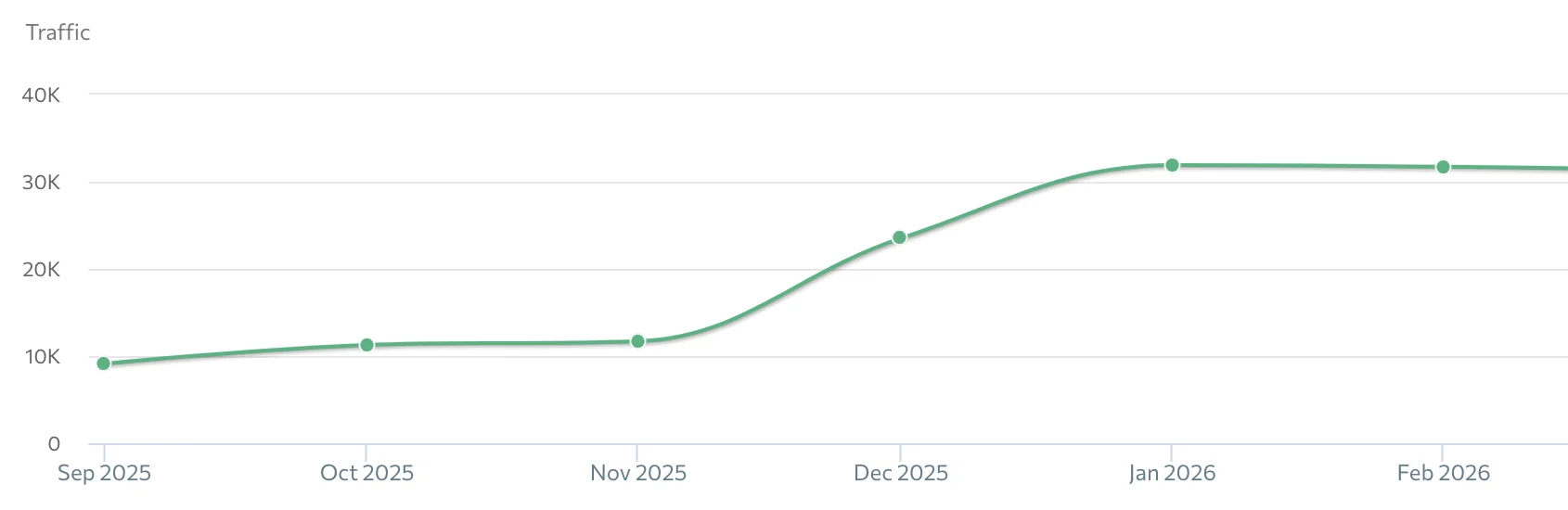
In one engagement, we grew a broker's organic traffic from 11,282 to 31,911 monthly visits between October 2025 and January 2026 (+181%), holding at 31,719 in February.
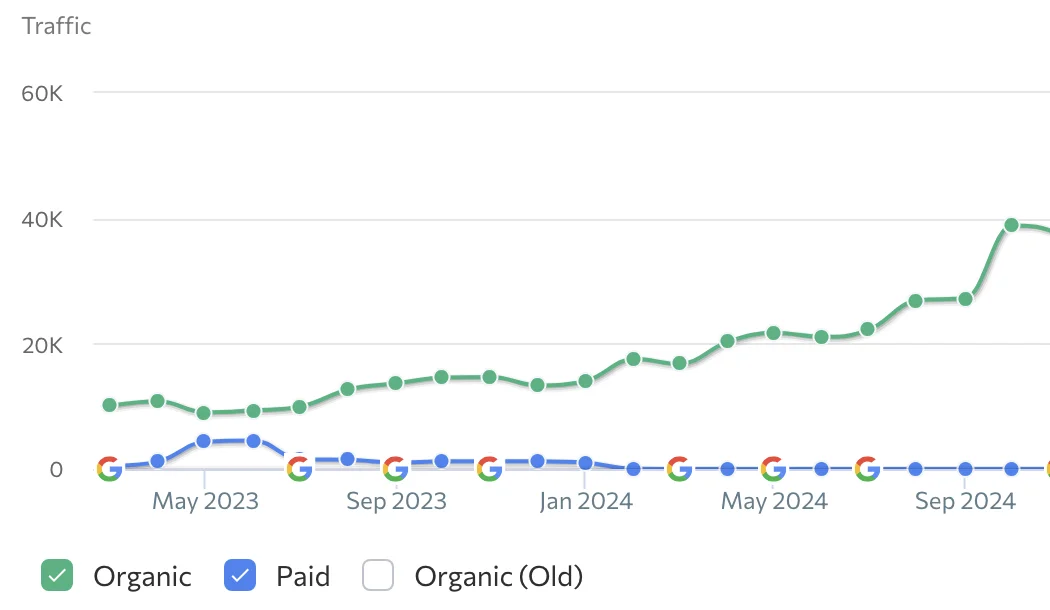
In a longer, in-house engagement, we built a leasing business's organic presence from 9,000 to 39,000 monthly visits between May 2023 and October 2024 (+333%). Leads increased 44%, cost per lead fell 85%, and the business started from zero leads at launch. It went on to win Large Leasing Broker of the Year and was acquired by a leading car marketplace.
This is why our complete marketing strategy guide positions organic search as the compounding asset that every other channel should support. Paid search fills gaps while organic builds; aggregators provide volume while organic builds qualityl; wsocial creates awareness while organic captures intent. The hierarchy matters and, more importantly, getting those channels to work together efficiently is the key.
The UK leasing sector is also structurally favourable for SEO. The BVRLA reported that the car lease fleet broke the 1.5 million vehicle barrier in 2025, with Business Contract Hire growing 7.8% year-on-year. More vehicles on lease means more people searching for information about leasing. The question is whether your site shows up when they do.
Keyword Research for Leasing Brokers
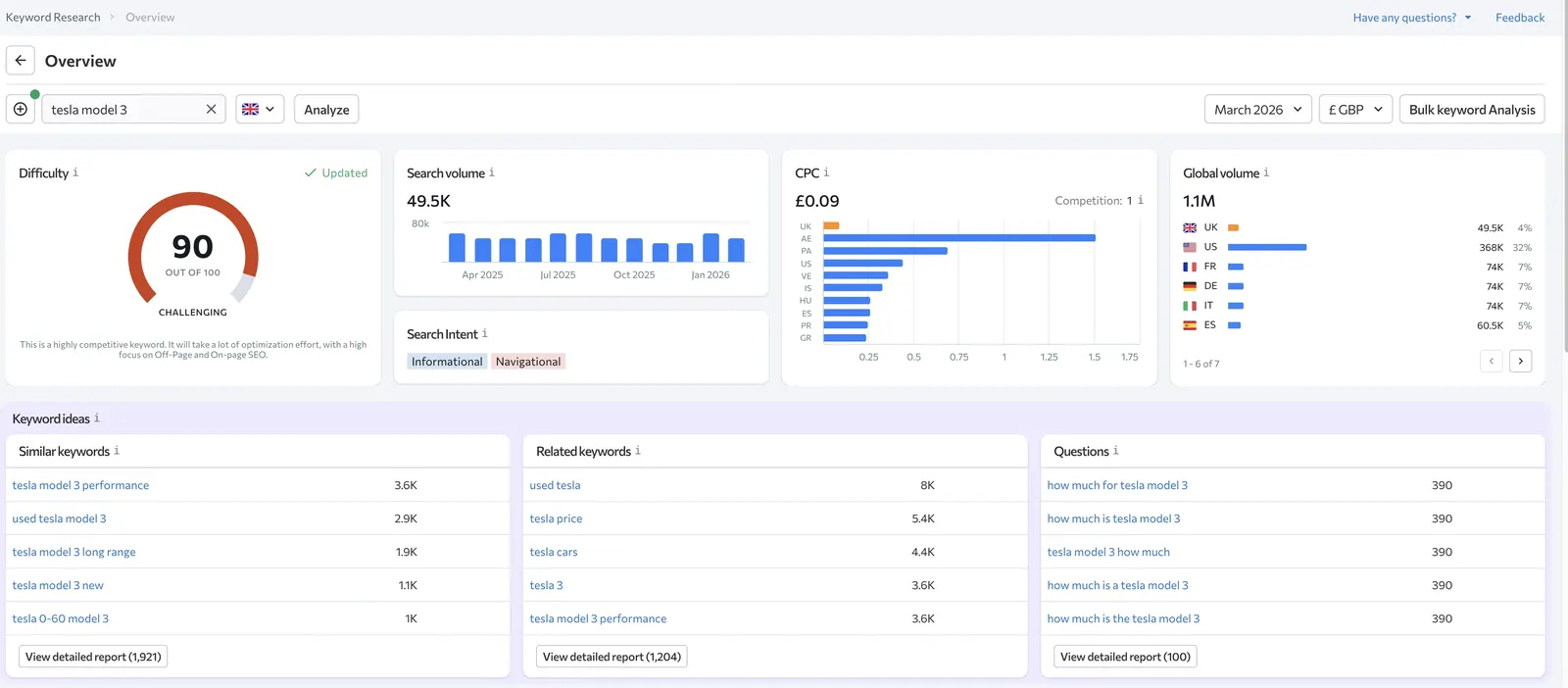
Keyword research for a leasing broker isn't the same exercise as for a general retailer or service business. The leasing sector has specific search patterns, seasonal rhythms and intent signals that generic keyword tools won't surface without contextual understanding.
Understanding search intent tiers
Leasing-related searches fall into three distinct intent tiers, and your SEO strategy needs content for each:
Tier 1: Transactional, model-specific. These are your highest-intent keywords. Someone searching "BMW 3 Series lease deals" or "Tesla Model Y personal lease UK" knows what they want and is comparing options. These pages need to exist on your site, optimised for the specific vehicle, and they need to convert. If you don't have dedicated pages for the vehicles you quote most, you're invisible at the moment of highest intent.
Tier 2: Informational, category-level. Searches like "is it better to lease or buy a car", "how does salary sacrifice car leasing work", or "business contract hire explained" indicate someone earlier in the journey. They're researching, not buying. Content that answers these questions thoroughly positions your brand as authoritative and captures prospects before they reach the price comparison stage. This is where your blog and guide content does its work.
Tier 3: Problem-aware, industry-specific. Searches like "how to reduce company car costs" or "how to manage fleet costs for SMEs" indicate a professional audience. For a broker targeting fleet or B2B business, these keywords attract decision-makers who are looking for expertise, not deals.
Practical keyword research process
You don't need expensive tools to start. Here's a process that works:
- Start with your sales conversations. The questions your prospects ask on the phone are the questions they type into Google. If customers regularly ask about early termination fees, maintenance inclusions, or the difference between PCH and BCH, those are article topics waiting to be written.
- Use Google's own data. Search Console shows you the queries your site already appears for, even if you're not ranking well. The "People also ask" boxes on Google results pages reveal the related questions searchers want answered. Both are free and specific to your market.
- Map keywords to pages. Every target keyword needs a destination page. If you're targeting "electric car lease deals UK", you need a dedicated page for that query, not a homepage that mentions electric vehicles in passing. This mapping exercise is the bridge between keyword research and content planning.
- Prioritise by commercial value, not search volume. A keyword with 50 monthly searches that attracts fleet managers is worth more than a keyword with 5,000 searches that attracts browsers with no budget. Prioritise the keywords that bring the customers you actually want to serve.
- Check what's currently ranking. Before writing content for a keyword, search it yourself. If the top results are from Vanarama, Auto Express and LeaseLoco, you're competing against high-authority domains and need to find a more specific angle. If the results are thin, outdated, or generic, there's a real opportunity to rank with better content.
Technical SEO: The Foundation Most Broker Sites Get Wrong
Technical SEO is the infrastructure that determines whether Google can discover, crawl, index and rank your content. You can write excellent content and target the right keywords, but if the technical foundation is weak, that content will underperform.
Most leasing broker websites have at least some of these common technical issues:
Site speed and Core Web Vitals
Google uses Core Web Vitals as a ranking signal. The three metrics that matter are Largest Contentful Paint (how fast your main content loads), Cumulative Layout Shift (how stable the page is as it loads), and Interaction to Next Paint (how quickly the page responds to user input).
For broker sites, the most common speed issues are unoptimised images (particularly vehicle images that haven't been compressed or served in WebP format), render-blocking JavaScript from third-party tools like chat widgets and analytics, and slow hosting. These are fixable, and fixing them often produces a noticeable ranking improvement within weeks.
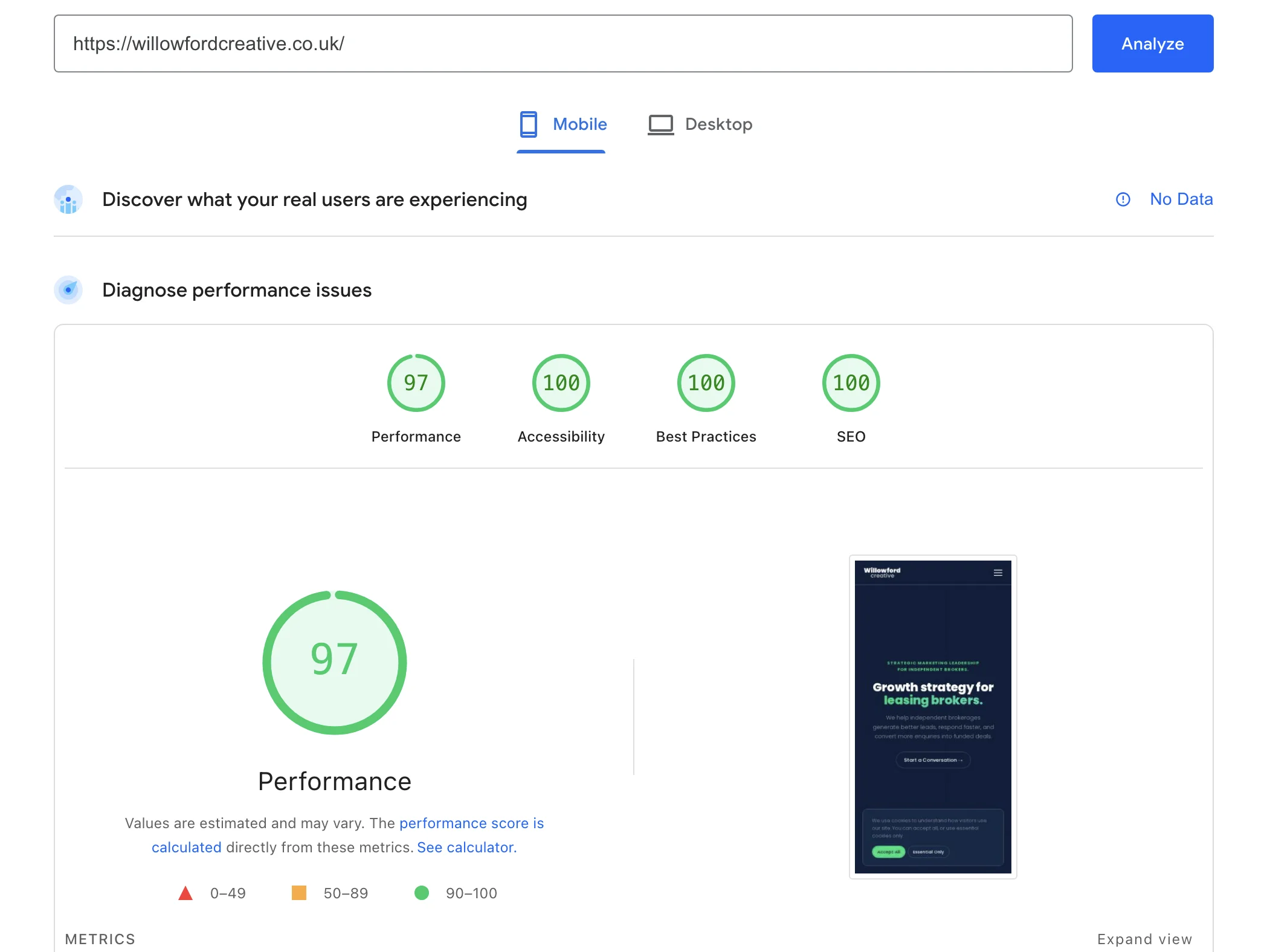
Run your site through Google PageSpeed Insights. If your mobile score is below 70, there's low-hanging fruit to pick.
Crawlability and indexation
Google needs to be able to find and index your pages. Common broker site issues include:
- No XML sitemap, or a sitemap that's outdated and doesn't include recent pages.
- Orphaned pages that exist but aren't linked from anywhere else on the site, so Google's crawler never finds them.
- Duplicate content from multiple URLs serving the same page (with and without trailing slashes, www and non-www variants, HTTP and HTTPS). Canonical tags solve this.
- Thin pages that exist for SEO purposes but contain so little content that Google considers them low quality. A 50-word page listing "BMW lease deals" with a contact form isn't useful to Google or to the user.
Structured data
Schema markup helps Google understand what your pages contain. For a leasing broker, the most valuable schema types are:
- LocalBusiness or FinancialService on your homepage and contact page, including your FCA registration details.
- Article or BlogPosting on your editorial content.
- FAQPage on pages with frequently asked questions (Google can display these as rich results).
- BreadcrumbList to help Google understand your site's hierarchy.
Implementing structured data doesn't directly improve rankings, but it can improve how your pages appear in search results, which improves click-through rate, which does improve rankings.
Mobile experience
Over 60% of leasing-related searches happen on mobile devices. If your site isn't genuinely mobile-friendly (not just "responsive" but actually usable on a phone), you're losing both rankings and conversions. Check that forms are easy to complete on mobile, that text is readable without zooming, and that tap targets are large enough to hit accurately.
I wanted to dig a little deeper into this.
I ran four sites through Google PageSpeed Insights on mobile. Three are ranking on page one for "car leasing". The fourth is sitting on page five.
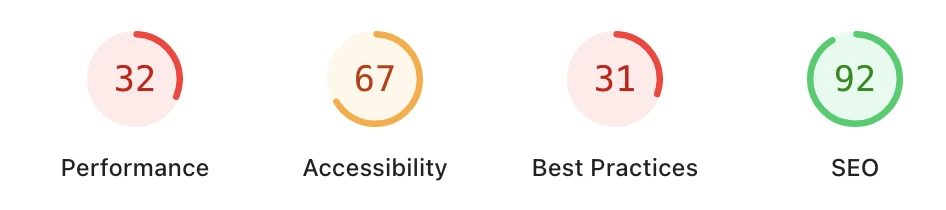
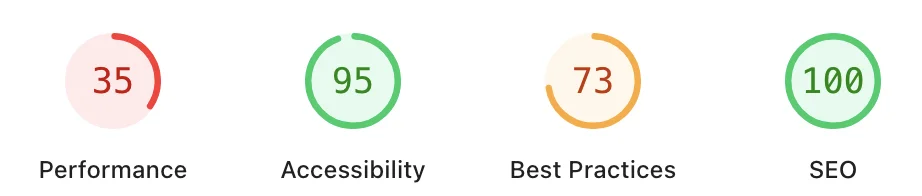

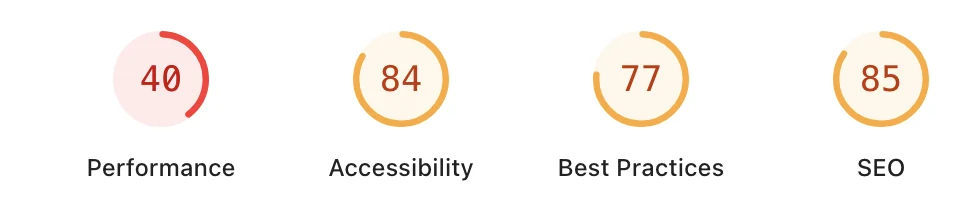
Performance scores: 32, 35, 37, 40. Every site — page one or page five, scored red on mobile performance. Not one cleared 50. The differences between them are marginal at best.
Look at the SEO scores and the gap widens slightly: the page one sites score between 75 and 100, while the page five brand scores 75. But that's hardly a chasm. The meaningful separation between ranking on page one and page five for one of the most competitive terms in the sector isn't being driven by technical SEO or mobile performance at all. It's domain authority, backlink profile, and brand signals doing the work. Our SEO and CRO teardown of the brands ranking for "car leasing" walks through exactly what that looks like in practice, with domain authority, backlinks and traffic trends for each.
Which tells you two things. First, if you're a newer or smaller broker with a weak backlink profile, you can't compensate with authority you haven't yet built, which makes getting the technical fundamentals right even more important. Second, the incumbents at the top of the results are not untouchable. They're ranking despite their technical performance, not because of it. A broker that builds authority deliberately while maintaining a genuinely fast, mobile-optimised site is building on a foundation none of the current top four have.
On-Page SEO for Leasing Broker Websites
On-page SEO is the practice of optimising individual pages to rank for specific keywords. Here's what matters for leasing broker pages:
Title tags and meta descriptions
Your title tag is the single most important on-page ranking factor. For a leasing broker page targeting "BMW 3 Series lease deals", the title tag should include that phrase naturally: "BMW 3 Series Lease Deals | Personal & Business Contract Hire | [Your Brand]".
Meta descriptions don't directly affect rankings but they affect click-through rate, which does. Write descriptions that give the searcher a reason to click: mention specific advantages (no deposit options, maintained packages, delivery timescales) rather than generic promises.
Heading structure
Use H1 for your primary keyword target (one per page), H2 for major sections, and H3 for subsections. This hierarchy tells Google what the page is about and how it's organised. Don't skip levels (going from H1 straight to H3) and don't use headings purely for visual styling.
Content depth and quality
Google's helpful content system rewards pages that demonstrate genuine expertise and provide comprehensive answers. For a leasing broker, this means:
- Answer the primary query directly in the first 150 words. If someone searches "how does business contract hire work", tell them in the opening paragraph, then expand.
- Include specific details that a generic article wouldn't have: typical deposit structures, contract lengths, maintenance inclusion options, early termination considerations.
- Reference real examples where possible. A page that says "BCH can save businesses up to 40% compared to outright purchase" is stronger with a worked example showing how.
- Write for the customer, not for Google. If the content reads like it was written to hit a keyword density target, it's doing the opposite of what you need.
Our guide to content architecture covers how to structure your content at scale so that individual pages reinforce each other's authority.
Internal linking
Internal links distribute authority across your site and help Google understand relationships between pages. Every page on your site should link to at least two or three related pages. Your vehicle category pages should link to relevant blog content. Your blog posts should link to service pages and to each other.
The anchor text you use for internal links matters. "Click here" tells Google nothing. "Our guide to Google Ads for leasing brokers" tells Google exactly what the linked page covers. Use descriptive, keyword-relevant anchor text naturally.
Local SEO: The Free Pipeline Most Brokers Ignore
Many leasing brokers operate nationally and assume local SEO doesn't apply to them. That's a missed opportunity. A significant proportion of leasing-related searches include geographic qualifiers: "car leasing broker near me", "business lease deals Manchester", "personal contract hire West Midlands". Even national brokers can capture this demand.
Google Business Profile
Your Google Business Profile (GBP) is the foundation of local SEO. If you haven't claimed and optimised yours, do it before anything else. It's free, and it can appear in both the local map pack and standard search results.
Key optimisation steps:
- Complete every field. Business name, address, phone, website, operating hours, service areas, business description. Google rewards completeness.
- Choose the right primary category. "Car leasing service" or "Vehicle leasing company" is more specific than "Financial service". The primary category has a significant impact on which searches trigger your profile.
- Add service areas. If you serve clients nationally, list the major cities and regions you want to appear for. If you focus on specific regions, list those.
- Post regularly. Google Business Profile posts (updates, offers, articles) signal that your business is active. Share your blog content, highlight current deals, or post company updates. Weekly posting is sufficient.
- Collect and respond to reviews. Review volume and recency are among the strongest local ranking factors. Ask satisfied customers for Google reviews, and respond to every review, positive or negative. This isn't just SEO; it's trust infrastructure.
Local content
Creating content that references specific locations can help you rank for geographic searches. This doesn't mean creating dozens of thin pages for every city in the UK. It means writing genuinely useful content with a local angle where it's natural: "Electric car leasing options for Birmingham businesses", "Salary sacrifice schemes: what West Midlands employers need to know".
Content Strategy and Topical Authority
We've covered content architecture in depth in our dedicated guide, but the SEO principles are worth summarising here.
Google assesses topical authority at the domain level. A site that has published ten well-structured, interlinked articles about leasing broker operations, marketing and technology signals to Google that it's an authoritative source on the topic. A site with one article and a homepage does not, regardless of how good that single article is.
The pillar-cluster model
The most effective content structure for leasing broker SEO follows the pillar-cluster model:
- Pillar pages cover broad topics comprehensively: leasing broker marketing strategy, for example. These target high-volume, competitive keywords.
- Cluster articles cover specific subtopics in depth: Google Ads for leasing brokers, social media marketing for leasing brokers, the leasing broker tech stack. Each cluster article links back to its pillar and to related clusters.
- Supporting content addresses long-tail queries and timely topics: EV fleet leasing strategy, speed to lead, the KPIs brokers should track.
This structure means every article you publish makes the entire cluster stronger. That's the compounding effect that makes SEO uniquely valuable as a marketing channel.
Not sure where your SEO stands? Our Growth Review covers your organic visibility, content architecture and keyword positioning as part of a structured commercial audit. It's a diagnostic, not a sales call.
Publishing cadence
Consistency matters more than frequency. One well-researched, genuinely useful article per month, published reliably, compounds significantly over twelve to eighteen months. Four articles published in one burst followed by three months of silence doesn't produce the same result. Google rewards sites that demonstrate sustained editorial commitment.
E-E-A-T and why it matters for brokers
Google's quality guidelines emphasise Experience, Expertise, Authoritativeness and Trustworthiness (E-E-A-T). For leasing brokers, this is actually an advantage. You have real experience in the sector. You understand the products, the customers and the commercial dynamics in a way that generic content writers don't.
Demonstrate that experience in your content: reference real scenarios (without naming clients), cite industry data from the BVRLA or FLA, explain the nuances that only someone who's actually worked in the sector would know. Our article on why AI isn't the marketing quick fix you think it is explores why this genuine expertise is becoming more, not less, important as AI-generated content floods the web.
Link Building for Leasing Brokers
Backlinks remain one of Google's strongest ranking signals. A link from another website to yours is, in Google's eyes, a vote of confidence in your content. But link building for leasing brokers doesn't need to involve expensive outreach agencies or guest posting on irrelevant sites.
Natural link opportunities for brokers
Industry directories. The BVRLA member directory, the FLA's broker listing, industry-specific directories, and your local Chamber of Commerce all provide legitimate backlinks. If you're registered with a funder panel, check whether they link to accredited brokers on their site.
Funder and partner relationships. If you have strong relationships with funders, manufacturer partners, or industry suppliers, a mutual link on a "partners" or "accredited brokers" page carries genuine authority.
Original research and data. Content that includes original data, benchmarks or analysis naturally attracts links. If you publish sector-specific insights (market trends, customer behaviour data, cost comparisons), other publishers in the automotive and finance space will reference and link to them.
Local press and trade publications. If you have something genuinely newsworthy to say about the leasing market, local business press and trade outlets like Fleet News, Business Car Manager or AM Online are receptive to well-written, expert commentary. A single link from a high-authority trade publication is worth more than fifty links from low-quality directories.
What to avoid
Don't buy links. Don't participate in link exchange schemes. Don't publish guest posts on irrelevant sites just for the backlink. Google's spam detection is sophisticated, and the short-term gain isn't worth the long-term risk. Focus on earning links through the quality and usefulness of your content.
Measuring SEO Performance
SEO is a long-term investment, and measuring its performance requires patience and the right metrics. Here's what to track:
The metrics that matter
Organic traffic. The total number of visitors arriving from non-paid search results. Track this monthly and look for the trend, not individual fluctuations. Google Search Console is free and shows this data accurately.
Keyword rankings. Track your target keywords weekly or monthly. Focus on movement and trends rather than individual position changes. A keyword moving from position 40 to position 15 over three months is progress, even if it's not on page one yet.
Organic conversions. Traffic alone isn't the goal; enquiries are. Set up conversion tracking in Google Analytics so you can measure how many organic visitors submit an enquiry form or make a phone call. This is the metric that connects SEO investment to pipeline.
Cost per acquisition from organic. Once you know your organic conversion volume, you can calculate cost per acquisition by dividing your total SEO investment (content, tools, any external support) by the number of orders generated from organic traffic. Compare this to your aggregator and paid search CPA to understand the relative value. Our guide to the KPIs brokers should track covers how to build this measurement layer across all channels.
Realistic timelines
SEO doesn't produce overnight results. Expect to see initial movement in keyword rankings within two to three months of sustained effort. Meaningful organic traffic growth typically begins at the four to six month mark. The compounding effect, where organic traffic grows without proportional increases in effort, usually becomes visible after twelve months of consistent publishing and technical maintenance.
This timeline is why many brokers underinvest in SEO: the payoff is delayed relative to paid search or aggregators, which produce enquiries immediately. But the brokers who commit to a twelve-month SEO programme consistently find that it becomes their most cost-effective acquisition channel by month eighteen.
Frequently Asked Questions
How long does it take for SEO to work for a leasing broker?
Two to three months for initial ranking movement, four to six for meaningful traffic. The compounding effect becomes clear after twelve months of consistent effort. Competitive head terms (like "car leasing") take longer than specific long-tail keywords (like "electric van salary sacrifice UK").
How much should a leasing broker spend on SEO?
Most independent brokers who see meaningful results invest £1,000 to £3,000 per month across content creation, technical SEO and tools. Consistency matters more than budget: £1,500 per month for twelve months produces better results than £5,000 per month for three months.
Can I do SEO myself or do I need an agency?
You can make significant progress yourself, especially with content creation and Google Business Profile optimisation. Technical SEO (site speed, structured data, crawlability) often benefits from specialist support. The worst option is a generalist agency that doesn't understand leasing; they'll target the wrong keywords and produce content that doesn't resonate with your actual customers.
Is SEO still worth it with AI overviews and featured snippets?
Yes. AI overviews increase the value of well-structured content, not reduce it. Google still needs source material for these features, and sites that provide clear, authoritative answers are the ones that get cited. Content that answers specific questions in the opening paragraph is more likely to appear in AI overviews than content that buries the answer.
Should I focus on SEO or Google Ads first?
Both, but with different roles. Use Google Ads to capture high-intent demand today while building organic content that captures that same demand for free in six to twelve months. As organic rankings improve, reduce paid spend on those terms and reallocate. This creates a deliberate transition from paid to organic that reduces overall cost per acquisition over time.