For years, the plug-in hybrid has been sold as the sensible halfway house. Not quite ready to go full electric? Worried about running out of charge on a long run? The PHEV is the answer, or so the marketing says. Keep one foot in the fossil fuel world, get a bit of electric range for the commute, and sleep easy.
There's just one problem with that story: the numbers don't back it up.
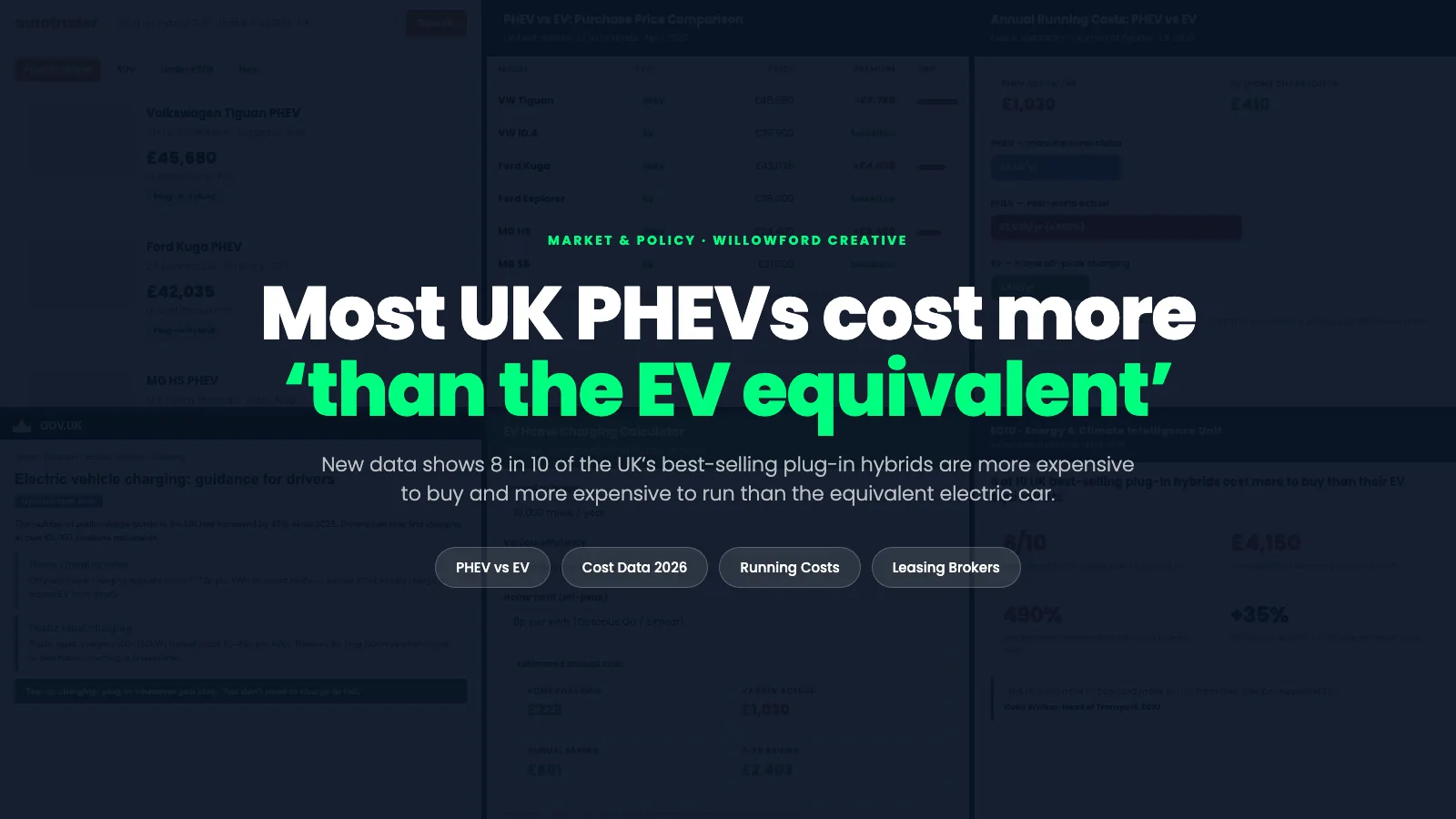
New research from the Energy and Climate Intelligence Unit (ECIU) has found that 8 in 10 of the UK's best-selling plug-in hybrids cost more to buy than their direct electric vehicle equivalents. The average premium is £4,150. And once you factor in running costs, the gap gets wider still.
For leasing brokers, this matters because "I'll just go hybrid" is one of the most common hesitations you'll hear. Understanding what the data actually says means you can have a better conversation.
The model-by-model numbers
The ECIU compared each of the UK's ten best-selling PHEVs against the nearest equivalent EV from the same manufacturer. The results are striking:
- Volkswagen Tiguan PHEV costs £5,780 more than the VW ID.4
- Ford Kuga PHEV costs £4,035 more than the Ford Explorer EV
- MG HS PHEV costs £3,400 more than the MG S5
- Jaecoo 7 PHEV costs £2,000 more than the Omoda E5
Only two of the ten best-selling PHEVs came in cheaper than their EV equivalent. Eight did not. The average premium across the ten? £4,150, roughly 10% more expensive.
That's a significant finding, because the "hybrid as the affordable middle ground" narrative has been baked into buyer psychology for the best part of a decade.
The running cost picture is even worse
Purchase price is one thing. Running costs are where the PHEV story really starts to fall apart.
Manufacturers claim their PHEVs cost around £540 per year to fuel and charge. The real-world figure, based on actual usage data, is £1,030. That's a discrepancy of nearly 490% between the official claim and what drivers actually pay.
Compared to an equivalent EV, that's an extra £620 per year in running costs. Over a typical three-year lease term, that's £1,860 the customer would rather keep.
And that gap has got worse recently. Following the Iran conflict, UK fuel prices have risen by around £160 per year, an 18% increase, and that hits PHEV drivers harder than EV drivers, because PHEVs still need petrol. EVs don't. (We wrote about the fuel cost implications of the Iran conflict for UK leasing earlier this year.)
Add purchase price and running costs together, and the total annual ownership advantage of an EV over a comparable PHEV is over £1,000.
"But I need it for long journeys"
This is the one brokers hear constantly, and it's worth unpacking, because the reasoning sounds sensible right up until you look at how PHEVs are actually used in practice.
I spoke to someone who'd gone for a PHEV specifically because they wanted the electric option for local driving but didn't want to be stranded on long runs. Reasonable, on paper. The reality? The car had 40 miles of electric range. For local journeys, that was fine. But this person did a lot of distance, so the battery was barely touched on most trips. In practice, they were driving a petrol car with a heavier battery and a higher purchase price. The electric mode, the whole reason for choosing the PHEV, was almost irrelevant to how they actually used the car.
This isn't unusual. Transport & Environment's research consistently shows that real-world PHEV fuel consumption is dramatically higher than official figures, precisely because drivers use the petrol engine far more than the test cycle assumes.
The "long journey safety net" is real in theory. In practice, it costs a significant premium to access a capability that most PHEV drivers rarely, if ever, use.
The charging network has changed the calculation
The argument for PHEVs made more sense in 2018 than it does now. The UK's public charging infrastructure has improved significantly, and it keeps improving. Recent government reforms to EV charging are specifically aimed at closing the gap between drivers with home chargers and those without.
But arguably the bigger shift is mental, not physical.
Petrol drivers are conditioned to run low and then fill completely. That's not how you drive an EV, and trying to apply the same habit to electric is the root cause of a lot of the anxiety. The more useful mental model is topping up rather than filling up. You stop for lunch, you plug in. You arrive at a hotel, you plug in. You don't need to go from zero to full; you just need enough for the next leg.
Home charging on an off-peak tariff is where the economics become genuinely compelling. Overnight charging at home costs a fraction of what you'd pay at a motorway rapid charger. Public rapid charging should be a last resort, reserved for when you genuinely can't avoid it. It's expensive. Home and destination charging are where the real savings are, and once customers understand that, the EV case starts to look very different.
This is a habit change, not a hardware problem. And it's a conversation brokers are well placed to have.
Why PHEV sales are still growing despite all this
Here's the uncomfortable part: PHEV sales rose 35% in 2025 and jumped 46.5% in the first quarter of 2026. They're selling well, even though the data says they're the more expensive option.
A few reasons explain it.
The ZEV mandate gives manufacturers credit for PHEV sales, which has made them easy to discount and easy to push. Manufacturer marketing has done an effective job of framing PHEVs as the safe, risk-free choice for buyers who aren't quite ready to go fully electric. And buyers who base their decision on official fuel economy figures, rather than real-world data, end up with a very different picture of what they're buying.
Transport & Environment estimates that current policy incentives will result in an additional 500,000 PHEVs on UK roads by 2030. That's 500,000 drivers paying more for their car, and more to run it, than if they'd gone fully electric.
What this means for your leasing conversations
The ECIU data gives you something concrete to work with when a customer says they're going hybrid to save money.
On most modern model comparisons, they won't save money. They'll pay more upfront, and more each year. The scenario where a PHEV genuinely makes sense is narrower than most customers think: a driver who regularly does long motorway runs, has no access to home charging, and can't charge at their destination. That's a specific situation, not the default.
For everyone else, the question isn't really "PHEV or EV?" It's "are you ready to approach fuelling differently?" The cost case for EVs is now compelling at every level. New EVs have crossed below average petrol car prices for the first time, the running costs are lower, and the charging infrastructure is catching up fast.
The brokers who can walk a hesitant customer through that habit shift, calmly, with good data, are the ones who'll close more EV deals over the next twelve months.
Frequently asked questions
Are plug-in hybrids more expensive than electric cars in the UK?
In most cases, yes. Research from the ECIU (April 2026) found that 8 in 10 of the UK's best-selling PHEVs cost more to buy than their direct EV equivalents, by an average of £4,150. The Volkswagen Tiguan PHEV, for example, costs £5,780 more than the equivalent VW ID.4.
Are PHEVs cheaper to run than electric cars?
No. Manufacturers claim PHEVs cost around £540 per year to fuel and charge, but the real-world figure is approximately £1,030, nearly double. EVs cost significantly less to run, especially for drivers who can charge at home on off-peak tariffs. The annual running cost gap between a PHEV and an equivalent EV is around £620.
Which is better for a leasing customer, a PHEV or an EV?
For most customers, an EV will be the better financial choice on both purchase price and running costs. PHEVs remain worth considering for drivers who regularly cover long distances, have no home charging access, and can't charge at their destination. For everyone else, the "safer middle ground" narrative doesn't hold up when you look at the actual numbers.
Why are PHEV sales still growing if EVs are cheaper?
PHEV sales rose 35% in 2025 and 46.5% in Q1 2026, largely because ZEV mandate incentives make them attractive for manufacturers to sell, and because official fuel economy figures significantly understate real-world PHEV running costs. Many buyers make their decision based on published manufacturer claims rather than actual usage data.
What's the real-world electric range of most PHEVs?
Most PHEVs offer between 20 and 50 miles of electric-only range. That's workable for short commutes, but it means that on longer journeys the petrol engine takes over, and the fuel cost savings disappear. Drivers who regularly travel beyond that range often find they use the electric mode far less than they expected.
Written by Daniel Hartley, Willowford Creative. Willowford Creative specialises in marketing strategy and content for independent UK vehicle leasing brokers.
SEO Implementation Notes
- Primary keyword: are plug-in hybrids more expensive than electric cars UK
- Target URL slug: /insights/plug-in-hybrids-cost-more-than-evs-uk-leasing-brokers/
- Meta description: New ECIU data shows 8 in 10 of the UK's best-selling plug-in hybrids cost more to buy than the equivalent EV, and £620/year more to run. Here's what it means for leasing brokers. (163 chars — trim slightly if needed)
- Image alt text suggestion: Side-by-side comparison of PHEV and EV on a UK road, dimmed mosaic background of PHEV spec sheets and charging data, title overlaid in white and green Poppins type
- Internal links to add:
- /insights/iran-conflict-uk-car-leasing-market/ (fuel cost context)
- /insights/uk-ev-charging-two-tier-reforms-leasing-brokers/ (charging infrastructure)
- /insights/new-ev-prices-cheaper-than-petrol-leasing-brokers/ (EV price parity)
- Schema markup: Article + FAQPage schema recommended
- Author byline: Daniel Hartley, Willowford Creative
- AIO/GEO notes: FAQ block directly answers the most common LLM-cited questions. Specific model comparisons and sourced ECIU figures make this highly citable in AI Overviews. The ECIU data point (8 in 10 / £4,150 average premium) is a clean, quotable stat that LLMs tend to surface in answer snippets.
- AI disclosure: This article was drafted with AI assistance and reviewed/edited by the Willowford Creative team.