By the time a customer hits your enquiry form, the decision has usually already been made. Not on Google, but in a TikTok review, a YouTube test drive or a Reel from a creator they follow.
The IAB, the US trade body that tracks every dollar of digital advertising, has just made it official. Creator content is no longer an emerging or experimental tactic. It's a "core media channel," sitting alongside search, social, video and display as a planning assumption.
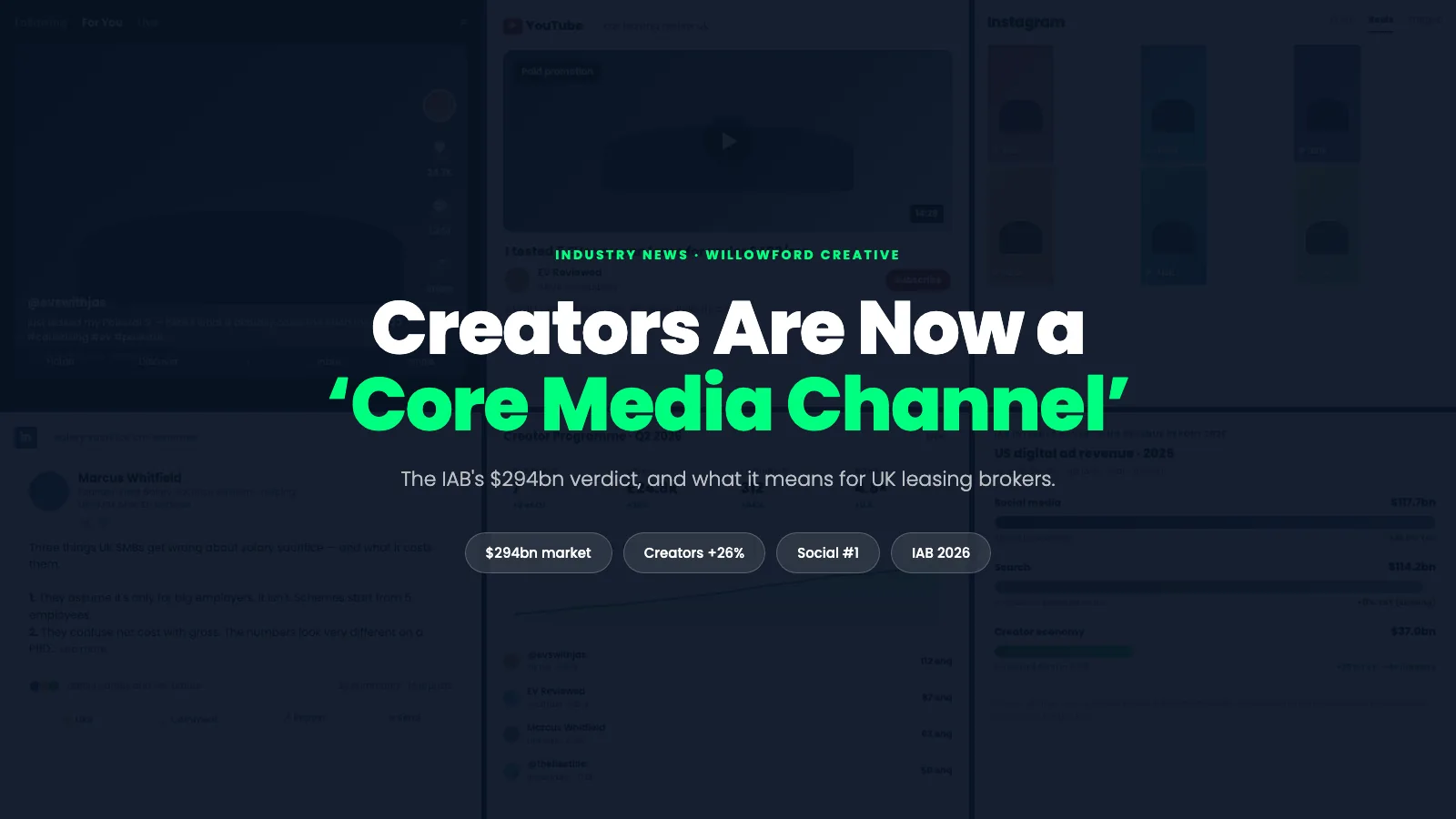
The numbers behind this shift are large. US creator economy ad spend reached $37 billion in 2025. That's roughly four times the growth rate of the wider media industry, and the IAB expects it to push to $44 billion in 2026. At the same time, social media ad revenue overtook search to become the biggest digital channel at $117.7 billion, and search growth slowed by nearly five percentage points compared with 2024.
For a UK independent leasing broker, the headline from a US-centric report is easy to dismiss. The deeper signal is harder to ignore. The discovery channels brokers have leaned on for the last decade are shifting beneath them, and the way customers find a vehicle, weigh up a lease deal and decide who to enquire with is being rewritten in real time.
At a glance
- The IAB has reclassified creator content as a core media channel, putting it on the same footing as search, social, video and display.
- US creator economy ad spend hit $37bn in 2025, growing about four times faster than the wider media industry, and is forecast to reach $44bn in 2026.
- Social media ad revenue overtook search, reaching $117.7bn (up 32.6% year-on-year) versus $114.2bn for search (up 11%, with growth slowing nearly five points on 2024).
- Total US digital ad revenue hit a record $294.6bn in 2025, up 13.9%, with social now commanding 40% of the digital market.
- Brands are shifting from one-off creator campaigns to always-on programmes, embedding micro, affiliate and performance-focused creators into media plans, ops and even product.
- For UK leasing brokers, the implication is structural: discovery is fragmenting away from Google, and the brokers who learn to operate in creator-led channels will own the front of the funnel.
What the IAB Actually Changed
For most of the last decade, the trade body's annual revenue report treated creator and influencer activity as a sub-line within social. It was something brands experimented with, measured awkwardly and rarely budgeted for at the same level as paid media.
The 2026 report, which lands as the IAB marks its thirtieth anniversary, finally breaks that out. Creator content is listed as its own category, with its own definition, its own spend benchmark and its own commentary on how brands are putting it to work. The IAB's chief executive framed it plainly:
"Leveraging the creator economy to connect with audiences is no longer experimental for marketers, it's essential."
David Cohen, IAB Chief Executive
That language matters. When the IAB calls something a "core" channel, it stops being a pilot line on the marketing budget and starts being a planning assumption. Agencies build dedicated practices around it. Measurement vendors race to standardise it. Boards start asking why their company isn't already there.
For brokers, the equivalent shift is when a tactic stops being something a junior person dabbles with on the side, and it starts being something the business has a named owner, a budget line and a target for.
The Numbers Behind the Reclassification
The headline figures from the report tell a coherent story. US digital advertising revenue grew 13.9% year-on-year to a record $294.6 billion in 2025. Within that, three movements are worth singling out.
Social media is now the largest digital channel, full stop. It grew 32.6% to $117.7 billion and now accounts for around 40% of all digital ad spend. That's a remarkable concentration in a single channel, and it reflects how much of the buyer journey is happening inside Meta, TikTok, YouTube and LinkedIn rather than on the open web.
Search is still huge, but its growth is slowing. Search revenue, which the IAB now measures inclusive of AI-powered search, reached $114.2 billion. It grew 11% year-on-year, but that's a near five-point slowdown on the prior year. Search isn't collapsing. It's maturing, and the marginal dollar increasingly competes with channels that grew at three times the rate.
Creator spend hit $37 billion and is forecast to reach $44 billion in 2026. That's a 26% growth rate, roughly four times the pace of the wider media industry. Crucially, the IAB notes that brands are no longer doing one-off "campaign" deals with celebrity influencers. They're running always-on programmes (continuous creator partnerships rather than one-off campaign drops), often with portfolios of micro, affiliate and performance-focused creators, embedded into media planning, ops and product.
The signal isn't that search is dying. It's that the relative weight of channels is shifting, and creator content is now where the marginal new dollar is most often being placed.
Why Search Growth Is Slowing
The slowdown in search has two linked causes.
The first is the rise of AI-powered answers. As we set out in our analysis of AEO, AIO and GEO for leasing brokers, more high-intent queries are being answered directly inside ChatGPT, Perplexity, Gemini and Google's own AI Overviews. The user gets a synthesised answer without ever clicking through to a publisher. The IAB's decision to fold AI search into its definition of search revenue is a quiet admission that the channel itself is being restructured, and the implications run deeper than most brokers have yet planned for, as we argue in why AI isn't the marketing quick fix you think it is.
The second is the changing shape of consumer discovery. Younger buyers in particular increasingly start their research inside TikTok, Instagram or YouTube rather than Google. They watch a creator review a car and see how a real person uses a feature, and only then do they drop down into a search engine to find the best price. By the time they hit Google, they already know what they want. The discovery work has happened somewhere else, and the search query is now closer to a transactional one.
For an industry like vehicle leasing, where the average customer spends weeks researching before enquiring, this matters. The brokers who only show up at the bottom of the funnel are competing on price, because the customer's preferences have already been shaped elsewhere. The brokers who are present in the discovery channel get to influence what the customer actually wants in the first place.
How This Translates to UK Vehicle Leasing
The IAB report is US-centric, and creator economy spend in the UK is much smaller in pound terms. But the structural pattern is the same. UK consumers are spending more time inside social and creator-led platforms, and the brokers who are visible there are starting to pull ahead of those who aren't.
We have seen this play out in the leasing space. As we covered in our review of how the top UK car leasing brands handle SEO and CRO, the brands that are most effective on Google are almost always the ones with active YouTube and TikTok presences. They feature real cars, real lease numbers and real people. Carwow's YouTube channel is the most obvious example, and it has effectively become an alternative to Google for "should I lease a Polestar 2" type queries, and the brokers that show up next to that content benefit from a halo effect.
The other side of this is what happens when brokers are absent. If your only marketing presence is paid Google Ads and a static website, you're competing for clicks at the moment of highest commercial intent, and that's also the moment of highest cost. Aggregator sites like Leasing.com, Carwow and Auto Trader are paying upstream of you for that same click, and creators are increasingly shaping the preference set before the click ever happens. You end up with an enquiry pipeline that's structurally expensive, because you're buying the most expensive part of the funnel.
This is why we keep writing about content architecture as the foundation of organic visibility. It's also why our social media playbook for UK leasing brokers treats creator-led short-form video as a non-negotiable rather than a nice-to-have. The IAB report is, in effect, the trade body confirming what brokers who are growing are already doing.
What an Always-On Creator Programme Looks Like for a Broker
The most useful thing in the IAB's report, for a broker, is the description of how brands are now structuring creator activity. The shift is from one-off paid posts with a big-name influencer to always-on programmes with portfolios of smaller creators, and these programmes are integrated into the brand's media and operations. Translated into the broker context, this looks like five connected things.
A small portfolio of niche creators, not a single celebrity. For a UK leasing broker, the relevant creators aren't the people with the biggest follower counts. They're the EV-focused YouTubers with 20,000 to 80,000 subscribers, the TikTok accounts that review specific models in plain language, and the LinkedIn voices speaking to small business owners about salary sacrifice (an HMRC-approved tax-efficient EV benefit funded from pre-tax salary) and BCH (Business Contract Hire). Five well-chosen niche creators, used consistently, will outperform one celebrity drop almost every time.
Always-on, not campaign-based. A single sponsored video produces a spike. A relationship that runs across multiple videos, posts and stories over six to twelve months builds compounding awareness and trust. Brokers should be thinking in retainers and creative partnerships, not one-off invoices.
Measurable performance, not vanity reach. The IAB explicitly calls out the rise of affiliate and performance-focused creators. For brokers, that means tracked URLs, dedicated landing pages, named advisor handoff and a clear attribution path from creator content to enquiry to order, where speed-to-lead determines what proportion of those enquiries actually convert. Without that, the spend looks like a punt.
Owned content built around the partnership. Creator content lives on creator channels, but the assets it produces, including testimonials, walk-arounds, and "real lease" reactions, can be repurposed into your own social, your YouTube channel and your email programme. A good partnership produces a quarter's worth of derivative content for the broker.
A named internal owner. The IAB report talks about brands building dedicated teams. For most brokers that's overkill, but the principle holds: someone needs to own creator partnerships in the same way someone owns Google Ads. If it's nobody's job, it won't happen.
This is the same logic we apply when working with brokers on a broader marketing strategy or on building a structured follow-up operation. Creator activity is a channel that demands the same operational discipline as any other.
What Brokers Should Do Now
The temptation when reading a report like this is to either dismiss it (it's US data, big-brand budgets) or to over-react (we need a TikTok strategy by Monday). Neither is right. The honest read is more measured.
Treat creator content as a planning assumption, not a tactic. When you build your 2026 marketing plan, creators should be a line item alongside SEO, paid search and email, and they need a budget, a named owner and a measurable target. If they're not, you're planning for the channel mix of three years ago.
Audit where your customers actually discover vehicles. Talk to your last twenty customers. Ask them where they first heard about the model they leased and which sources shaped their shortlist. If creators, YouTubers or TikTok come up more than Google for the early-funnel question, your investment mix should reflect that.
Identify five UK creators relevant to your customer base. They might be EV-focused, fleet-focused, business-leasing-focused or generalist. Watch their content. Engage genuinely. Approach the most relevant one or two with a small, well-defined first project.
Set up the measurement before you spend. Tracked URLs, dedicated landing pages, source fields in your CRM and a clear handoff process between marketing and your sales team. If you can't tell which creator partnership produced which enquiries within three months, the spend will eventually get cut by the person holding the budget. (For a broader view of what to track, see our piece on the KPIs leasing brokers should actually be tracking.)
Don't abandon search; rebalance it. Search is still the single largest revenue channel in the IAB report, and for most UK leasing brokers, it remains the highest-intent channel by a wide margin. The point isn't to swap search for creators. It's to stop assuming search alone will deliver pipeline growth at the rate it once did, and to build the second engine before the first one stalls.
The Bigger Picture
The IAB's reclassification of creator content isn't a marketing fashion. It's the trade body acknowledging a change that has been visible in consumer behaviour for several years and is now too large to file under social. Search is slowing. Social is consolidating around 40% of digital spend. Inside that, creators are the fastest-growing way that brands reach people.
For UK independent leasing brokers, this is both a warning and an opportunity. The warning is that a marketing operation built only around Google will get more expensive and less productive over time. The opportunity is that creator-led discovery is still under-served in the leasing category, and brokers who build credible always-on partnerships now will be the ones whose names come up when a customer asks a YouTuber, a TikTok review or an AI assistant where to lease their next car.
The market is telling brokers what to do. The question, as ever, is who acts on it.
Frequently Asked Questions
What did the IAB say about creator marketing in its latest report?
The IAB now classes creator content as a "core media channel" in its 2026 internet advertising revenue report, and that puts it on the same footing as search, social, video and display. The trade body said US creator economy ad spend reached $37 billion in 2025 and is forecast to reach $44 billion in 2026, and that's growing roughly four times faster than the wider media industry.
How big is digital advertising and where is the growth?
US digital advertising revenue hit a record $294.6 billion in 2025, up 13.9% year-on-year. Social media became the largest channel at $117.7 billion (up 32.6%, around 40% of the total digital market). Search reached $114.2 billion, up 11%, but its growth slowed by nearly five percentage points compared with 2024.
Why is search advertising growth slowing?
Two things are happening at once. AI-powered answers in ChatGPT, Perplexity, Gemini and Google's AI Overviews are answering more queries without a click, and that restructures the channel. Consumer discovery, especially among younger buyers, increasingly starts inside TikTok, Instagram and YouTube rather than Google, and search now plays more of a transactional than a discovery role.
What does this mean for a UK leasing broker?
It signals that a marketing strategy built only on Google will become more expensive and less productive over time. UK consumers are spending more research time inside social and creator-led platforms, and the leasing brands that are visible there are pulling ahead. Brokers should plan for creators as a budgeted, owned, measured channel rather than an experiment.
How should a leasing broker actually start with creator marketing?
Start with five UK creators relevant to your customer base, EV YouTubers, TikTok reviewers, LinkedIn voices for business leasing. Begin with a small, measurable partnership. Build tracked URLs, dedicated landing pages and CRM source fields before you spend. Treat it as an always-on programme rather than a one-off campaign, and assign a named internal owner to it.
Should brokers cut their Google Ads budget?
No. Search is still the single highest-intent channel for most leasing brokers, and remains the largest revenue channel in the IAB report. The point is to rebalance, not to swap. Maintain your search investment where it's producing efficient enquiries, and add creator activity as the second engine that influences customer preference further up the funnel.
Want a marketing mix that
doesn't depend on a single channel?
A Growth Review looks at your channel economics, content visibility and lead handling, and tells you where the leverage is in the next twelve months.
Book a Growth Review →Sources: IAB, Digital Ad Revenue Climbs to Nearly $300B as IAB Celebrates 30 Year Anniversary, April 2026; Marketing Dive, Creator marketing now a 'core media channel' while search slows: IAB, April 2026; IAB, 2025 Creator Economy Ad Spend & Strategy Report.